
Debt Service Coverage Ratio (DSCR): Definition & Calculation
The Debt Service Coverage Ratio (DSCR) measures the ability of a company to use its operating incomeOperating IncomeOperating income is the amount of revenue left after deducting the operational direct and indirect costs from sales revenue. to repay all its debt obligations, including repayment of principal and interest on both short-term and long-term debtLong Term DebtLong Term Debt (LTD) is any amount of outstanding debt a company holds that has a maturity of 12 months or longer. It is classified as a non-current liability on the company’s balance sheet. The time to maturity for LTD can range anywhere from 12 months to 30+ years and the types of debt can include bonds, mortgages. This ratio is often used when a company has any borrowings on its balance sheetBalance SheetThe balance sheet is one of the three fundamental financial statements. The financial statements are key to both financial modeling and accounting. such as bondsBondsBonds are fixed-income securities that are issued by corporations and governments to raise capital. The bond issuer borrows capital from the bondholder and makes fixed payments to them at a fixed (or variable) interest rate for a specified period., loans, or lines of credit. It is also a commonly used ratio in a leveraged buyoutLeveraged Buyout (LBO)A leveraged buyout (LBO) is a transaction where a business is acquired using debt as the main source of consideration. transaction, to evaluate the debt capacity of the target company, along with other credit metrics such as total debt/EBITDADebt/EBITDA RatioThe net debt to earnings before interest, taxes, depreciation, and amortization (EBITDA) ratio measures financial leverage and a company’s ability to pay off its debt. Essentially, the net debt to EBITDA ratio (debt/EBITDA) gives an indication as to how long a company would need to operate at its current level to pay off all its debt. multiple, net debt/EBITDA multiple, interest coverage ratio,Interest Coverage RatioInterest Coverage Ratio (ICR) is a financial ratio that is used to determine the ability of a company to pay the interest on its outstanding debt. and fixed charge coverage ratioFixed-Charge Coverage Ratio (FCCR)The Fixed-Charge Coverage Ratio (FCCR) is a measure of a company’s ability to meet fixed-charge obligations such as interest and lease expenses..
Debt Service Coverage Ratio Formula
There are two ways to calculate this ratio:
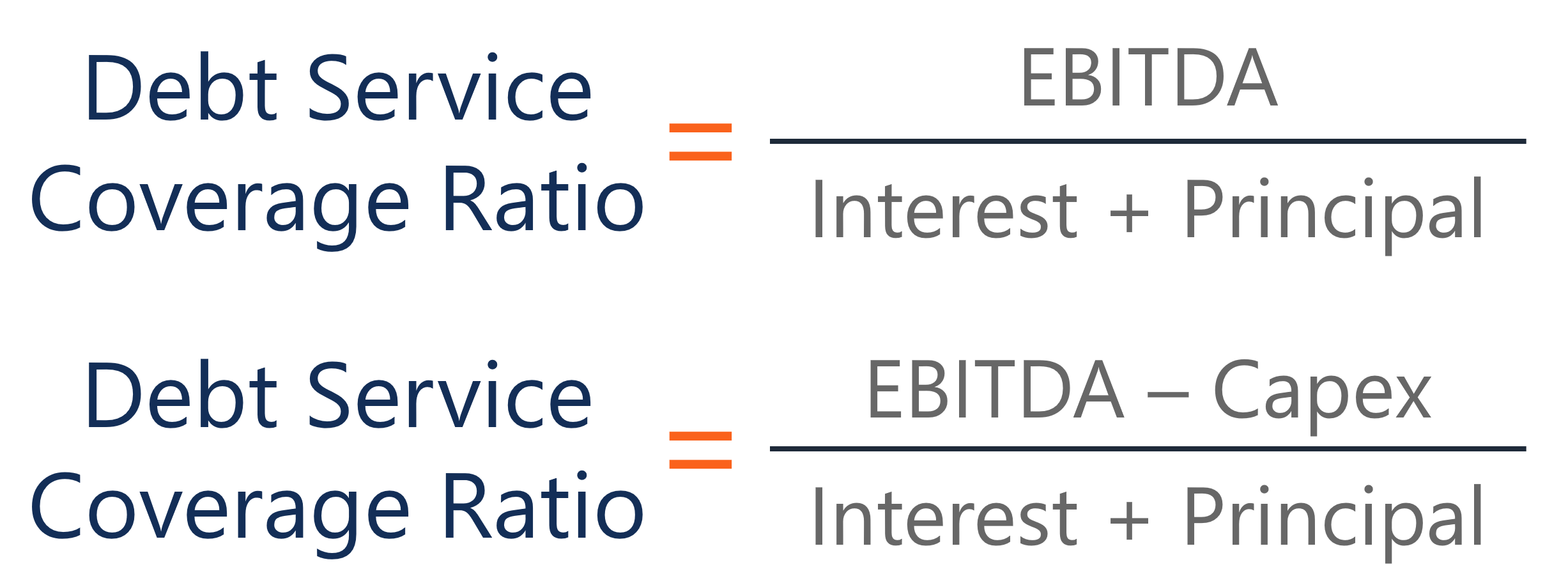
Where:
- EBITDAEBITDAEBITDA or Earnings Before Interest, Tax, Depreciation, Amortization is a company's profits before any of these net deductions are made. EBITDA focuses on the operating decisions of a business because it looks at the business’ profitability from core operations before the impact of capital structure. Formula, examples = Earnings Before Interest, Tax, Depreciation, and Amortization
- Principal = the total loan amount of short-term and long-term borrowings
- Interest = the interest payable on any borrowings
- CapexCapital ExpenditureA capital expenditure (“CapEx” for short) is the payment with either cash or credit to purchase long term physical or fixed assets used in a = Capital Expenditure
Some companies might prefer to use the latter formula because capital expenditure is not expensed on the income statementIncome StatementThe Income Statement is one of a company's core financial statements that shows their profit and loss over a period of time. The profit or but rather considered as an “investment”. Excluding CAPEX from EBITDA will give the company the actual amount of operating income available for debt repayment.
Debt Service Coverage Ratio Example
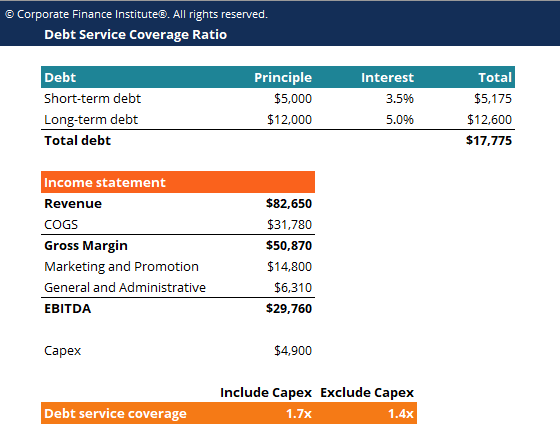
Consider a company which has short-term debt of $5,000 and long-term debt of $12,000. The interest rate on the short-term debt is 3.5% and the interest rate on the long-term debt is 5.0%. Capital expenditure in 2018 is $4,900.
The company’s income statement is as follows:
Revenue82,650COGS31,780Gross Margin50,870Marketing and Promotion Expense14,800General and Administrative Expense6,310EBITDA29,760
We can use the two formulas to calculate the ratio:
Debt service coverage ratio (including Capex) = 29,760 / (5,000 x (1 + 3.5%) + 12,000 x (1 + 5.0%)) = 1.7x
Debt service coverage ratio (excluding Capex) = (29,760 – 4,900) / (5,000 x (1 + 3.5%) + 12,000 x (1 + 5.0%)) = 1.4x
Thus, the ratio shows the company can repay its debt service 1.7 times with its operating income and 1.4 times with its operating income, less capex.
Download the Free Template
Enter your name and email in the form below and download the free template for the debt service coverage ratio now!
Interpretation of the Debt Service Coverage Ratio
A debt service coverage ratio of 1 or above indicates that a company is generating sufficient operating income to cover its annual debt and interest payments. As a general rule of thumb, an ideal ratio is 2 or higher. A ratio that high suggests that the company is capable of taking on more debt.
A ratio of less than 1 is not optimal because it reflects the company’s inability to service its current debt obligations with operating income alone. For example, a DSCR of 0.8 indicates that there is only enough operating income to cover 80% of the company’s debt payments.
Rather than just looking at an isolated number, it is better to consider a company’s debt service coverage ratio relative to the ratio of other companies in the same sector. If a company has a significantly higher DSCR than most of its competitors, that indicates superior debt management. A financial analyst may also want to look at a company’s ratio over time – to see whether it is trending upward (improving) or downward (getting worse).
Common Uses of the Debt Service Coverage Ratio
- The debt service coverage ratio is a common benchmark to measure the ability of a company to pay its outstanding debt including principal and interest expense.
- DSCR is used by an acquiring company in a leveraged buyoutLeveraged Buyout (LBO)A leveraged buyout (LBO) is a transaction where a business is acquired using debt as the main source of consideration. to assess the target company’s debt structure and ability to meet debt obligations.
- DSCR is used by bank loan officers to determine the debt servicing ability of a company.
Additional Resources
CFI is the official global provider of the Financial Modeling & Valuation Analyst (FMVA)Become a Certified Financial Modeling & Valuation Analyst (FMVA)®CFI's Financial Modeling and Valuation Analyst (FMVA)® certification will help you gain the confidence you need in your finance career. Enroll today!®Become a Certified Financial Modeling & Valuation Analyst (FMVA)®CFI's Financial Modeling and Valuation Analyst (FMVA)® certification will help you gain the confidence you need in your finance career. Enroll today! Become a Certified Financial Modeling & Valuation Analyst (FMVA)®CFI's Financial Modeling and Valuation Analyst (FMVA)® certification will help you gain the confidence you need in your finance career. Enroll today! certification, designed to transform anyone into a world-class financial analyst. Check out some of our resources below to expand your knowledge and further your career!
-

Fixed-Charge Coverage Ratio (FCCR): Definition & Importance
The Fixed-Charge Coverage Ratio (FCCR) is a measure of a company’s ability to meet fixed-charge obligations such as interest expensesInterest ExpenseInterest expense arises out of a company that
-

Debt Service Coverage Ratio (DSCR): Calculation & Importance
The debt service coverage ratio (DSCR) is used to
finance
- Asset Coverage Ratio: Understanding Financial Solvency
- Cash Flow to Debt Ratio: Understanding and Calculation
- Coverage Ratio: Understanding Your Company's Debt Repayment Ability
- Debt-to-Asset Ratio: Definition, Calculation & Significance
- Debt-to-Assets Ratio: Definition, Calculation & Risk Assessment
- Debt-to-Equity Ratio: Definition, Calculation & Importance
- Net Debt to EBITDA Ratio: Understanding Financial Leverage
- Debt Service Coverage Ratio (DSCR): Calculation & Importance
- Loan Life Coverage Ratio (LLCR): Definition & Importance
-
 Understanding the Retention Ratio: Reinvesting for Growth
The retention ratio (also known as the net income retention ratio) is the ratio of a company’s retained income to its net incomeNet IncomeNet Income is a key line item, not only in the income st...
-
 Sharpe Ratio: Calculate & Interpret Investment Performance
Named after American economist, William Sharpe, the Sharpe Ratio (or Sharpe Index or Modified Sharpe Ratio) is commonly used to gauge the performance of an investment by adjusting for its risk.The hig...