
Understanding Equity Risk Premium: Definition & Calculation
Equity Risk Premium is the difference between returns on equity/individual stock and the risk-free rate of return. The risk-free rate of return can be benchmarked to longer-term government bonds,Bond IssuersThere are different types of bond issuers. These bond issuers create bonds to borrow funds from bondholders, to be repaid at maturity. assuming zero default risk by the government. It is the excess return a stock pays to the holder over and above the risk-free rate for the risk the holder is taking. It is the compensation to the investor for taking a higher level of risk and investing in equity rather than risk-free securities.
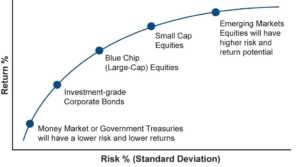
Equity risk premium and the level of risk are directly correlated. The higher the risk, the higher is the gap between stock returnsCapital Gains YieldCapital gains yield (CGY) is the price appreciation on an investment or a security expressed as a percentage. Because the calculation of Capital Gain Yield involves the market price of a security over time, it can be used to analyze the fluctuation in the market price of a security. See calculation and example and the risk-free rate and hence, a higher premium. Empirical data also validates the concept of equity risk premium. It proves that in the longer term, every investor will be rewarded for taking a higher risk.
For a rational investor, an increase in risk associated with an investment must be accompanied by a rise in potential reward from that investment for the investment to remain viable. For example, if government bonds are giving an investor 6% returns, any rational investor would choose the stock of any company only if it gave more than 6% returns, say 14%. Here, 14% – 6% = 8% is the equity risk premium.
Risk-Free Asset
A Risk-Free Asset is an asset whose returns in the future are known with certainty. It comes from complete confidence in the issuer of the asset. We consider government securities to be risk-free assets. The government would, theoretically, never default on the interest and principal payments of its securities. This is because the government has the option of self-financing its debt. It can borrow from the central bank or print more currency. Hence, risk-free assets are exposed to zero default risk and negligible inflation risk.
Calculating Equity Risk Premium
The formula:
Equity Risk Premium (on the Market) = Rate of Return on the Stock Market − Risk-free Rate
Here, the rate of return on the market can be taken as the return on the concerned index of the relevant stock exchange, i.e., the Dow Jones Industrial AverageDow Jones Industrial Average (DJIA)The Dow Jones Industrial Average (DJIA), also referred to as "Dow Jones” or "the Dow", is one of the most widely-recognized stock market indices. in the United States. Often, the risk-free rate can be taken as the current rate on long-term government securities.
Capital Asset Pricing Model and Equity Risk Premium
The Capital Asset Pricing Model, popularly known as CAPMCapital Asset Pricing Model (CAPM)The Capital Asset Pricing Model (CAPM) is a model that describes the relationship between expected return and risk of a security. CAPM formula shows the return of a security is equal to the risk-free return plus a risk premium, based on the beta of that security, is a model for calculating the expected returns of a security based on their systematic risk calculated by the Beta coefficient. According to the CAPM, there are two components of returns to an investor. The first component is the time value of money that is given by the risk-free rate of return and the second is the compensation for the risk investors take that is represented by the risk premium.
CAPM can be described using the following equations:
Ra = Rf + βa (Rm – Rf)
Where:
- Ra = Expected return on security ‘a’
- Rf = Risk-free rate of return
- Rm = Expected return on the market
- βa = Beta of ‘a’, and,
- βa = Covariance of Market Return with Stock Return / Variance of Market Return
Here, βa is the risk coefficient of stock ‘a’ which is unique to that particular stock. It measures the stock’s volatility using measures of dispersion.
βa = Covariance of Market Return with Stock Return / Variance of Market Return
Equity Risk Premium = Ra – Rf = βa (Rm – Rf)
Numerical Example
Consider the following example. The return on a 10-year government bond is 7%, the beta of security A is 2, and the market return is 12%. Then, the equity risk premium according to the CAPM method is as follows:
βa (Rm – Rf) = 2(12% – 7%) = 10%
Download the Free Template
Enter your name and email in the form below and download the free template now!
Related Reading
Check out the following resources from CFI to learn more about risk and investing.
- Investing: A Beginner’s GuideInvesting: A Beginner's GuideCFI's Investing for Beginners guide will teach you the basics of investing and how to get started. Learn about different strategies and techniques for trading
- Bond PricingBond PricingBond pricing is the science of calculating a bond's issue price based on the coupon, par value, yield and term to maturity. Bond pricing allows investors
- Fixed Income TradingFixed Income TradingFixed income trading involves investing in bonds or other debt security instruments. Fixed income securities have several unique attributes and factors that
- Capital Asset Pricing ModelCapital Asset Pricing Model (CAPM)The Capital Asset Pricing Model (CAPM) is a model that describes the relationship between expected return and risk of a security. CAPM formula shows the return of a security is equal to the risk-free return plus a risk premium, based on the beta of that security
-
Understanding Rate of Return: A Comprehensive Guide
A Rate of Return (ROR) is the gain or loss of an investment over a certain period of time. In other words, the rate of return is the gainCapital Gains YieldCapital gains yield (CGY) is the price appre
-

Understanding Financial Risk: A Comprehensive Guide
In finance, risk is the probability that actual results will differ from expected results. In the Capital Asset Pricing Model (CAPM)Capital Asset Pricing Model (CAPM)The Capital Asset Pricing Model (C
finance
- Understanding the Maturity Risk Premium in Fixed-Income Investments
- Understanding CAPM: A Comprehensive Guide to Capital Asset Pricing
- Default Risk Premium: Understanding & Calculation
- Liquidity Premium: Definition, Calculation & Investment Implications
- Market Risk Premium: Definition & Calculation | Investopedia
- Return on Common Equity (ROCE): Definition & Importance
- Return on Equity (ROE): Definition & Calculation | [Your Company Name]
- Understanding Risk and Return in Investing
- Equity Risk Premium Explained: Understanding Investment Risk & Return
-
 Understanding Negative Equity: Causes, Risks & Solutions
The concept of negative equity arises when the value of an asset (which was financed using debt) falls below the amount of the loan/mortgage that is owed to the bank in exchange for the assetTangible ...
-
 Understanding Operating Risk: A Key Component of Business Risk
Operating risk is the risk related to a company’s cost structure. More specifically, it is the risk the company faces due to the level of fixed costs in its operations. Together with sales ...