
Understanding Flash Crashes: Causes & Impact on Markets
Flash crashes refer to a scenario where the price of bondsBondsBonds are fixed-income securities that are issued by corporations and governments to raise capital. The bond issuer borrows capital from the bondholder and makes fixed payments to them at a fixed (or variable) interest rate for a specified period., stocksCommon StockCommon stock is a type of security that represents ownership of equity in a company. There are other terms – such as common share, ordinary share, or voting share – that are equivalent to common stock., or commodities suddenly plunges but then quickly recovers. It is called a flash, as the marketCapital MarketsCapital markets are the exchange system platform that transfers capital from investors who want to employ their excess capital to businesses will crash suddenly but then prices will almost immediately rebound. At the end of the day, the net result appears almost as though the crash had never occurred.

Quick Summary Points
- Flash crashes are when there is a sudden plunge in prices with stocks, commodities, and bonds followed by a quick recovery
- Some causes of flash crashes include the use of algorithm trading which can increase volatility and decrease liquidity
- It is difficult to pinpoint exactly what causes flash crashes
What causes flash crashes?
As noted, flash crashes happen extremely quickly. It is clear that the drop and rebound in price are not because of the release of bad news and then good news immediately after. Another point to consider is that the crash can impact an entire stock index, not just one stock, bond, or commodity. The cause of the crash is not usually due to any perceived change in the fundamental valueValueIn accounting terms, value is the monetary worth of an asset, business entity, goods sold, services rendered, or liability or obligation acquired. In of the stock.
One cause of flash crashes stems from computer programProgrammingProgramming is the process of writing instructions for a computer to perform. It is similar to a recipe for humans. A recipe contains a list of actionss or algorithms. Using algorithms to trade has become increasingly popular. Computers can take large amounts of data and make large volume tradesSales and TradingSales and Trading (S&T) is a group at an investment bank that consists of salespeople, who call institutional investors with ideas and opportunities, and traders, who execute orders and advise clients on entering and exiting financial positions. Sales and trading is the lifeblood that makes or breaks a securities firm within a second, outside of human capabilities of reasoned decision making. Some algorithms are programmed to react to selling pressures. For example, as more sells are made, compared to buys, the algorithms start selling, too. This creates a snowball effect and at the speed with which computers make trades, a sudden plunge in the market occurs.
High-frequency traders are another factor that is believed to have caused or worsen flash crashes. These traders use algorithms to perform large transactions at very high speeds. Traders can also purposely use algorithms to partake in illegal trades such as spoofing. With spoofing, algorithms are programmed to put in fake sales. For example, the traders will put in an order to sell 400 sales, but pull the order right before it is satisfied. By simply placing such a large sell order, prices are driven down, and the traders will then buy at the reduced price. With algorithms, this process has become very effective and is now illegal. This is just one way in which algorithms can create volatility in markets.
More research needed
Based on the research of flash crashes that have happened, there are still a lot of unknowns concerning why these crashes occur. While high-frequency traders and the use of algorithms play a part in pressuring prices up or down and promoting herd behavior, it is believed that there are other factors at play as well. It is also sometimes difficult to say whether there is a way for people or companies to purposely create flash crashes to earn a profit.
Examples of flash crashes
Flash crashes occur frequently. However, most are very small and do not make the news. The first notable flash crash was the 2010 Flash Crash2010 Flash CrashThe 2010 Flash Crash is the market crash that occurred on May 6, 2010. During the 2010 crash, leading US stock indices, including the Dow. During this crash, the Dow Jones index lost almost 9% of its value and around $1 trillion in equity in a very short space of time. However, the index was able to recover 70% of its decline by the end of the trading day. This flash crash was especially significant for several reasons. First, it was especially notable due to the large plunge in value and was reported by many news outlets. Second, it brought attention to the role that computer algorithms can play in creating market volatility and uncertainty.
2019 Yen and Australian dollar
At the beginning of 2019, the Yen suddenly increased in relative value by 7% against the Australian dollar. The increase happened within minutes without any notice. This could have occurred due to a variety of reasons, including lower than normal liquidity and fear of global slowdown. One contributing factor was that on the morning of the crash, Apple stated that its profits were down due to a slowdown in China. The news drove investors to buy the yen, which is considered a safe-haven currency.
Additional Resources
Thank you for reading CFI’s article on flash crashes. To keep learning and advancing your career, we recommend these CFI resources.
- Noise TraderNoise TraderA noise trader is an individual who trades based on incomplete or inaccurate data, often trading irrationally. Noise traders often make trades based on hype
- Bargain PurchaseBargain PurchaseA bargain purchase refers to a transaction where the acquirer of an enterprise gets a good bargain far lower than the fair market value of the enterprise
- London Stock ExchangeLondon Stock Exchange (LSE)The London Stock Exchange (LSE), which is based in London, the United Kingdom, is one of the leading stock markets in the world. Owned by the London Stock Exchange Group, the LSE was established in 1571, making it one of the oldest stock exchanges in the world
- Forex TradingForex Trading - How to Trade the Forex MarketForex trading allows users to capitalize on appreciation and depreciation of different currencies. Forex trading involves buying and selling currency pairs based on each currency's relative value to the other currency that makes up the pair.
-

Understanding Proceeds: Definition, Types & Calculation
Proceeds refers to the cash received from the sale of goods or assetsTypes of AssetsCommon types of assets include current, non-current, physical, intangible, operating, and non-operating. Correctly i
-
Understanding Quick Assets: Definition & Examples
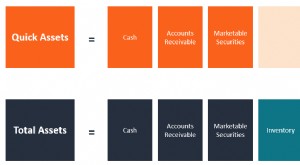
Quick assets are those assets that can be converted into cash within a short period of time. The term is also used to refer to assets that are already in cash form. They are considered to be the most
finance
- Understanding Agency Costs: Protecting Shareholder Interests
- CCPPO Shares Explained: Understanding Cumulative, Convertible, & Participating Preferred Stock
- Understanding Company Bylaws: A Comprehensive Guide
- Corporate Bonds: A Comprehensive Guide to Investing
- Understanding Earnings: A Guide to Financial Profitability
- Understanding Efficiency Ratios: A Key to Business Performance
- Understanding Excess Reserves: What Banks Hold & Why It Matters
- Fidelity Bonds: Protection Against Employee Dishonesty & Fraud
- Financial Covenants: Definition, Types & Importance
-
 Outstanding Shares: Definition & Importance for Investors
Outstanding shares represent the number of a company’s shares that are traded on the secondary market and, therefore, available to investors. Outstanding shares include all restricted sharesRest...
-
 Preferred Shares: A Comprehensive Guide for Investors
Preferred shares (also known as preferred stock or preference shares) are securities that represent ownership in a corporationCorporationA corporation is a legal entity created by individuals, stockho...