
Fixed-Charge Coverage Ratio (FCCR): Definition & Importance
The Fixed-Charge Coverage Ratio (FCCR) is a measure of a company’s ability to meet fixed-charge obligations such as interest expensesInterest ExpenseInterest expense arises out of a company that finances through debt or capital leases. Interest is found in the income statement, but can also and lease expensesOperating LeaseAn operating lease is an agreement to use and operate an asset without ownership. Common assets that are leased include real estate,. The FCCR is a broader measure of the interest coverage ratio, more complete by virtue of the fact that it also includes other fixed costsFixed and Variable CostsCost is something that can be classified in several ways depending on its nature. One of the most popular methods is classification according such as leases. As with other commonly used debt ratios, a higher ratio value – preferably 2 or above – indicates a more financially healthy, and less risky, company or situation. A lower ratio value – less than 1 – indicates that the company is struggling to meet its regularly scheduled payments.
Learn more about important financial ratios for tracking company health with CFI’s Loan Covenants course!
Fixed-Charge Coverage Ratio Formula
The formula for calculating the fixed-charge coverage ratio is as follows:

Where:
- EBITDAEBITDAEBITDA or Earnings Before Interest, Tax, Depreciation, Amortization is a company's profits before any of these net deductions are made. EBITDA focuses on the operating decisions of a business because it looks at the business’ profitability from core operations before the impact of capital structure. Formula, examples stands for earnings before interest, taxes, depreciation, and amortization.
- Fixed charges are regular, business expenses that are paid regardless of business activity. Examples of fixed charges include debt installment payments and business equipment lease payments.
Example of Fixed-Charge Coverage Ratio
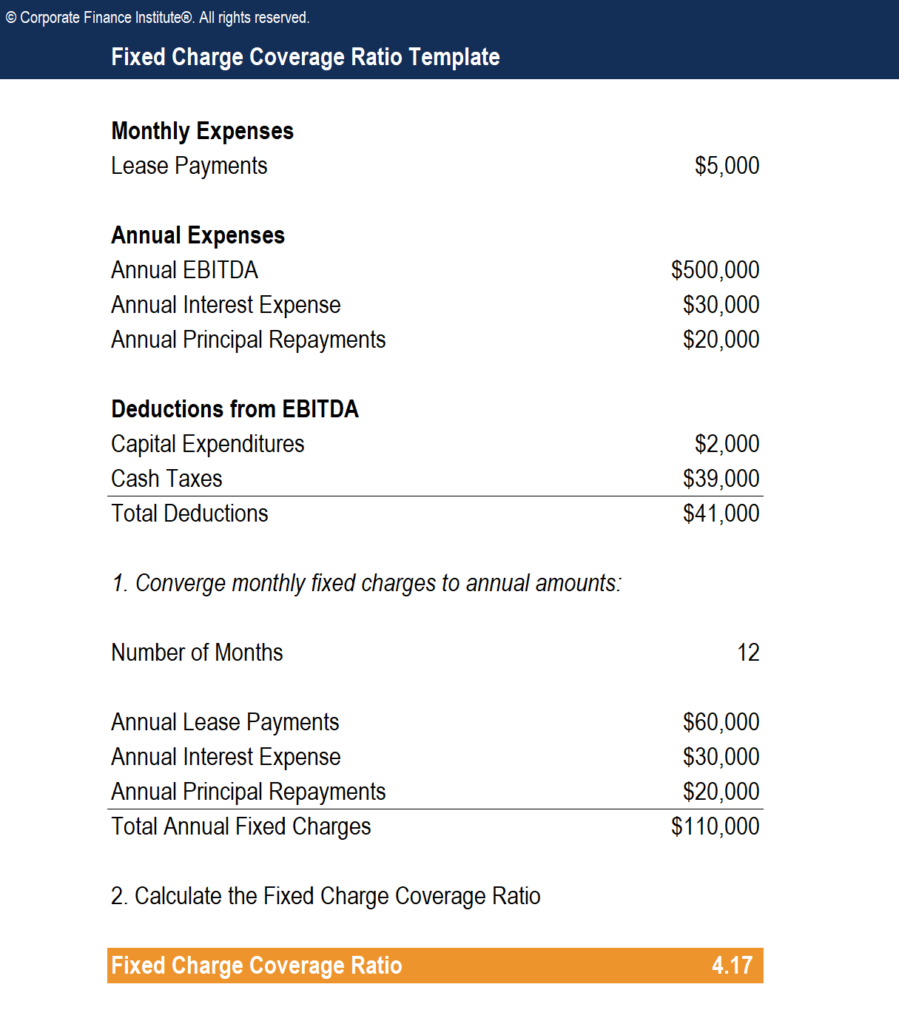
Jeff operates a salon in the city of Vancouver. The salon’s monthly expenses include lease payments of $5,000. Jeff’s salon generated EBITDA of $500,000 and has an annual interest expense of $30,000. Additionally, it also has annual principal repayments of $20,000. Every year, it spends $2,000 to replace some salon equipment. This current year, Jeff paid $39,000 in taxes. The fixed-charge coverage ratio for Jeff’s salon would be calculated as follows:
1. Converge monthly fixed-charges to annual amounts and add annual charges:
- Monthly lease payments of $5,000 x 12 = $60,000 annually
- Annual interest payments of $30,000
- Annual principal repayments of $20,000
Therefore, annual fixed-charges (interest + principal + capital lease payments) equate to $60,000 + $50,000 = $110,000
2. Apply the FCCR formula:

CFI’s Loan Covenants course will teach you more about important ratios for tracking financial health!
Download the Free Template
Enter your name and email in the form below and download the free template now!
Interpretation of the Fixed-Charge Coverage Ratio
The FCCR is used to determine a company’s ability to pay its fixed payments. In the example above, Jeff’s salon would be able to meet its fixed payments 4.17 times. The fixed-charge coverage ratio is regarded as a solvency ratio because it shows the ability of a company to repay its ongoing financial obligations when they are due. If a company is unable to meet its recurring monthly or annual financial obligations, then it is in serious financial distress. Unless the situation is remedied quickly, efficiently, and safely, it is unlikely that the company will be able to remain financially afloat for very long.
Here is a way to evaluate the FCCR number:
- An FCCR equal to 2 (=2) means that the company can pay for its fixed charges two times over.
- An FCCR equal to 1 (=1) means that the company is just able to pay for its annual fixed charges.
- An FCCR of less than 1 (<1) means that the company lacks enough money to cover its fixed charges.
Therefore, generally speaking, the higher the fixed-charge coverage ratio value, the better, as this indicates a company operating on solid financial ground, with adequate revenues and cash flows to meet its regular payment obligations.
The FCCR is often used by lenders or market analysts to assess the sufficiency of a company’s cash flows to handle the company’s recurring debt obligations and regular operating expenses.
Fixed-Charge Coverage Ratio and the Times Interest Earned Ratio
The fixed-charge coverage ratio is similar to the more basic “times interest earned ratio”, a debt or financial solvency ratio that uses earnings before interest and taxes (EBIT) to determine a company’s ability to successfully handle its debt obligations.
Compare the times interest earnedInterest Coverage RatioInterest Coverage Ratio (ICR) is a financial ratio that is used to determine the ability of a company to pay the interest on its outstanding debt. ratio formula shown below with the formula for the fixed-charge coverage ratio as shown above.

You may want to view the FCCR as a more conservative assessment of a company’s financial health because it takes into consideration additional fixed charges besides just interest payments, such as leases and insurance.
Other Resources
CFI is a leading provider of financial analysis courses for investment banking professionals, including the Financial Modeling & Valuation Analyst (FMVA)™ Become a Certified Financial Modeling & Valuation Analyst (FMVA)®CFI's Financial Modeling and Valuation Analyst (FMVA)® certification will help you gain the confidence you need in your finance career. Enroll today!certification program. To help you advance your career, check out the additional CFI resources below:
- Financial LeverageFinancial LeverageFinancial leverage refers to the amount of borrowed money used to purchase an asset with the expectation that the income from the new asset will exceed the cost of borrowing.
- Leverage RatiosLeverage RatiosA leverage ratio indicates the level of debt incurred by a business entity against several other accounts in its balance sheet, income statement, or cash flow statement. Excel template
- Profitability RatiosProfitability RatiosProfitability ratios are financial metrics used by analysts and investors to measure and evaluate the ability of a company to generate income (profit) relative to revenue, balance sheet assets, operating costs, and shareholders' equity during a specific period of time. They show how well a company utilizes its assets to produce profit
- Analysis of Financial StatementsAnalysis of Financial StatementsHow to perform Analysis of Financial Statements. This guide will teach you to perform financial statement analysis of the income statement,
-

Reserve Ratio Explained: Understanding Bank Reserves
The reserve ratio – also known as bank reserve ratio, bank reserve requirement, or cash reserve ratio – is the percentage of deposits a financial institution must hold in reserve as cash.
-

Understanding the Retention Ratio: Reinvesting for Growth
The retention ratio (also known as the net income retention ratio) is the ratio of a company’s retained income to its net incomeNet IncomeNet Income is a key line item, not only in the income st
finance
- Acid-Test Ratio: Understanding Your Company's Short-Term Liquidity
- Asset Turnover Ratio: Definition & Calculation - Financial Analysis
- Debt Service Coverage Ratio (DSCR): Definition & Calculation
- Debt-to-Asset Ratio: Definition, Calculation & Significance
- Defensive Interval Ratio (DIR): Understanding Company Liquidity
- Understanding the Envy Ratio in Private Equity
- Interest Coverage Ratio (ICR): Definition & Importance
- Net Debt to EBITDA Ratio: Understanding Company Solvency
- Pretax Margin Ratio: Definition & Analysis | Financial Insights
-
 Operating Ratio: Definition, Calculation & Importance
The operating ratio is a measure of efficiency that is used by management to determine day-to-day operational performance. This metric compares operating expenses, also known as OPEX, to net sales. Th...
-
 Quick Ratio: Understanding Your Business's Short-Term Liquidity
The Quick Ratio, also known as the Acid-test or Liquidity ratio, measures the ability of a business to pay its short-term liabilities by having assets that are readily convertible into cashCash Equiva...