
Residual Dividend Policy: Definition, Pros & Cons
A business with a residual dividend policy holds zero excess cash at any given point in time. All spare cash must be either reinvested in the business or redistributed among the shareholders.
Imperfections in the capital marketCapital MarketsCapital markets are the exchange system platform that transfers capital from investors who want to employ their excess capital to businesses make it rare for a company to follow a pure residual dividend policy. Most businesses instead follow smooth dividend policies that call for regular dividends that show some correlation with the business’ past and present earnings.
What is a Dividend?
Shareholders receive a dividend, which is a portion of current profits, for investing in the company. They can receive dividends in many different ways, including receiving additional stock or cash payments. The board of directors of a company decides how much of a dividend the company will pay out and follows a certain dividend policyDividend PolicyA company’s dividend policy dictates the amount of dividends paid out by the company to its shareholders and the frequency with which the dividends are paid when distributing the company’s profits.
Many investors find dividends attractive because they provide a regular stream of income. Usually, dividends are paid out quarterly (in line with the company’s earnings reports), but in certain instances, a company may choose to pay out a special or irregular dividend.
Residual Dividend Policy vs. Smooth Dividend Policy
The graph below shows the dividends paid out by two companies over a 10-year period. The companies show identical earnings and investments but follow different dividend policies.
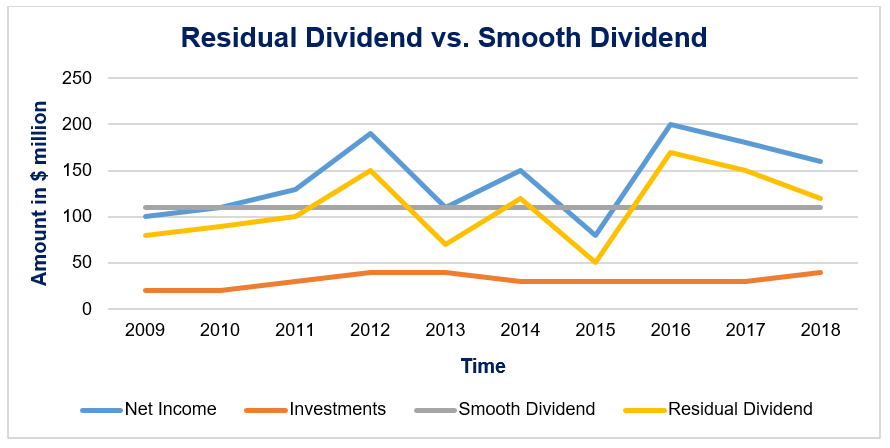
The company following a smooth dividend policy pays out $110 million as dividend payments each year of the 10-year period. The company following a residual dividend policy makes varying dividend payments over the same period of time. In 2015, it paid out only $50 million in dividend payments, whereas, in 2016 it paid out $170 million in dividends.
It should also be noted that, in 2009, the company following a smooth dividend policy spent $20 million on investments and $110 million on dividend payments despite only reporting a net income of $100 million. The additional $30 million in dividend payments must have been financed either through past earnings of the business or through short-term borrowingShort Term LoanA short term loan is a type of loan that is obtained to support a temporary personal or business capital need. from a bank. This is consistent with empirical evidence that suggests that businesses tend to prefer a smooth dividend payout profile and use financial institutions to finance such dividends when necessary.
In theory, a residual dividend policy is more efficient than a smooth dividend policy. If at any point in time a business can find no further profitable investments, then they should return any spare cash available to the shareholders so that the shareholders may use the cash to invest in other projects that they believe will be profitable.
Thus, a residual dividend policy ensures that cash is efficiently distributed toward profitable investments. Under a smooth dividend policy, the management of a business may invest spare cash into unprofitable or unnecessarily risky projects only because funds are available.
Residual Dividend Model
Dividends = Net Income – (Target Equity Ratio x Total Capital Budget)
Illustrative Example of the Residual Dividend Model
Consider a business with a capital budget of $8,000,000. The business follows a 60-40 debt-equity split that they wish to maintain. The company makes a net income forecast of $5,000,000. Also, the business reports total equity of $3,200,000 (Total Equity = 40% of $8,000,000 = $3,200,000). The residual dividend paid is $1,800,000 ($5,000,000 – $3,200,000). The business shows a payout ratio of 36% ($1,800,000/$5,000,000). Consider the following alternative cases:
Case A
Net income drops to $3,000,000. Since the total equity of the business is $3,200,000, the entire amount is retained. Dividends paid and the dividend payout ratio are both 0.
Case B
Net income rises to $8,000,000. Since the total equity of the business is $3,200,000, $4,800,000 ($8,000,000 – $3,200,000 = $4,800,000) is paid out as dividends. The dividend payout ratio is 60% ($4,800,000/$8,000,000).
Advantages and Disadvantages of a Residual Dividend Policy
A residual dividend policy usually requires fewer new stock issues and lower flotation costs. However, a variable dividend policy may send conflicting signals to investors. It also represents an increased level of risk for investors, as dividend income remains uncertain.
Related Readings
CFI is the official provider of the Financial Modeling and Valuation Analyst (FMVA)™Become a Certified Financial Modeling & Valuation Analyst (FMVA)®CFI's Financial Modeling and Valuation Analyst (FMVA)® certification will help you gain the confidence you need in your finance career. Enroll today! certification program, designed to transform anyone into a world-class financial analyst.
To keep learning and developing your knowledge of financial analysis, we highly recommend the additional CFI resources below:
- Financial IntermediaryFinancial IntermediaryA financial intermediary refers to an institution that acts as a middleman between two parties in order to facilitate a financial transaction. The institutions that are commonly referred to as financial intermediaries include commercial banks, investment banks, mutual funds, and pension funds.
- Important Dividend DatesImportant Dividend DatesIn order to understand dividend-paying stocks, knowledge of important dividend dates is crucial. A dividend typically comes in the form of a cash distribution that is paid from the company's earnings to investors.
- Internal Rate of Return (IRR)Internal Rate of Return (IRR)The Internal Rate of Return (IRR) is the discount rate that makes the net present value (NPV) of a project zero. In other words, it is the expected compound annual rate of return that will be earned on a project or investment.
- Stable Dividend PolicyStable Dividend PolicyA business with a stable dividend policy pays out a steady dividend every given period, regardless of the volatility in the market. The exact amount of dividends that are paid out depends on the long-term earnings of the company.
-
Understanding Asset Disposition: Definition & Tax Implications
A disposition refers to the disposal of assets or securities through assignment, sale, or another transfer method. It is simply the transfer of an asset’s ownership, where the asset is either gi
-

Qualified Dividends: Tax Benefits & Requirements Explained
A qualified dividend is a type of payment that is made by a corporation to its shareholders. When this payment is received, the investor will have to pay capital gains tax, instead of regular in
finance
- Understanding & Calculating Residual Dividend Policy: A Comprehensive Guide
- Understanding Residual Property: What Happens When There's No Will?
- Accelerated Dividends: Understanding Early Dividend Payments
- Constant Dividend Payout Ratio: Definition & Implications
- Cost of Equity: Definition, Calculation & Importance
- Understanding Dividends: A Comprehensive Guide
- Understanding Stable Dividend Policies: A Comprehensive Guide
- Stock Dividends: Definition, Types & How They Work
- Understanding Dividend Policy: A Comprehensive Guide
-
 Special Dividends: Understanding One-Time Distributions
A special dividend, also referred to as an extra dividend, is a non-recurring, “one-time” dividend distributed by a company to its shareholders. It is separate from the regular cycle of di...
-
 Understanding Dividend Yield: A Comprehensive Guide
The dividend rate is the amount of cash returned by a company to its stockholders on an annual basis as a percentage of the market valueMarket ValueMarket value is usually used to describe how much an...