
Understanding Conversion Premium: A Guide for Investors
A conversion premium is an amount of money that is paid that exceeds the value of a security. The owner of the bond has the opportunity to convert back on into a specified number of shares of common stock. In order to calculate the convertible premium, you first have to know the value of the shares of stock that the bond can be converted into.
An Example
For example, if the bond can be converted into 10 shares of common stock that are worth $90 apiece, the value of that conversion would be $900. If the bond is trading for $1100, the conversion premium would be the difference between the $1100 and $900 or $200.
Trading for a Premium
Convertible bonds often trade for a higher price than what the conversion into a different security would equal. They are willing to pay a premium for this type of security because it has multiple options. They can hang onto the bond and receive regular coupon payments or they have the right to convert it into stock.
-
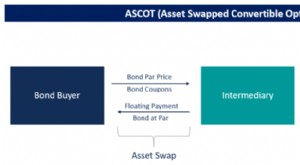
ASCOT Options: Understanding Asset-Swapped Convertible Options
The term ASCOT is short for Asset Swapped Convertible Option Transaction. It is an American style call option to buy back a convertible bond. It falls under the category of financial products called s
-

Asset Swap Explained: Definition, OTC Trading & Key Concepts
An asset swap is a derivative contract between two parties that swap fixed and floating assets. The transactions are done over-the-counterOver-the-Counter (OTC)Over-the-counter (OTC) is the trading of
Stock basis
- Personal Bond Explained: Release from Jail Without Bail
- Understanding Bond Duration: A Key Fixed Income Metric
- Understanding Amortizable Bond Premiums: A Comprehensive Guide
- Call Premium Explained: Understanding Issuer Redemptions & Option Pricing
- Coupon Bonds: Understanding Fixed Income & Interest Payments
- Discount Bonds: Understanding Pricing & Secondary Markets
- Understanding Noncallable Securities: A Comprehensive Guide
- Samurai Bonds: A Guide to Understanding Yen-Denominated Corporate Debt
- Treasury Bonds: A Comprehensive Guide to U.S. Government Debt
-
 Understanding Bond Accretion: A Comprehensive Guide
Accretion is a finance term that refers to the increment in the value of a bond after purchasing it at a discount and holding it until the maturity date. A bond is said to be purchased at a discount p...
-
 Amortized Bonds: Understanding Principal Repayment
An amortized bond is a bond with the principal amount – otherwise known as face value –regularly paid down over the life of the bond. The bond’s principal is divided up according to ...