
Understanding the Par Yield Curve: A Guide for Investors
The par yield curve is a graphical representation that shows the yield to maturityYield to Maturity (YTM)Yield to Maturity (YTM) – otherwise referred to as redemption or book yield – is the speculative rate of return or interest rate of a fixed-rate security. (YTM) for various types of bonds. Often, it is used to examine if treasury bonds are a strong investment in current market bond conditions. It gives the single discount rate that would be used to discount the entirety of the bonds’ cash flow in the open market at the present price.
Line charts are typically used to visually show the researcher the relationship between different bond yields and market interest rates. A par yield curve occurs when the yield to maturity of the security being purchased is at par with treasury bond interest rates.
The graph shows the yield to maturity of coupon bondsCoupon BondA coupon bond is a type of bond that includes attached coupons and pays periodic (typically annual or semi-annual) interest payments during its lifetime and its par value at maturity. These bonds come with a coupon rate, which refers to the bond's yield at the date of issuance. at their different maturity dates. It is the total return that an investor expects to make if they hold the instrument until its maturity. As the interest rate fluctuates over time, the yield to maturity increases or decreases to reflect the current rate environment.
Summary
- The par yield curve is a graphical representation that gives the yield to maturity (YTM) for various types of bonds.
- The graph shows the yield to maturity of coupon bonds at their different maturity dates, which is the total return that an investor expects to make if they hold the instrument until its maturity.
- Generally, the par yield curve falls below the spot and forward yield curve in normal market situations.
How is a Par Yield Curve Affected by Interest Rates?
If interest rates decrease after bond issuance, the value of the bond will see a consequent increase. It is because the coupon rate on the bond is now higher than the current rate in the market.
Thus, the interest rate will consequently be higher than the yield to maturity and will be visually represented in the visualized yield curve. “Par yield” occurs when bond and interest rates are trading at par, meaning that the bond interest rates and interest rates in the open marketOpen MarketAn open market is an economic system with no trade barriers to free market activities. In an open market, buyers and sellers can do business freely without are identical to one another.
The pay yield curve is only used in the primary market when new bond rates are issued. The logic behind such reasoning is that the issuer would not want to issue bonds that are made unattractive due to interest rates. Visually, a par yield curve can look like many other yield curves, depicted below:
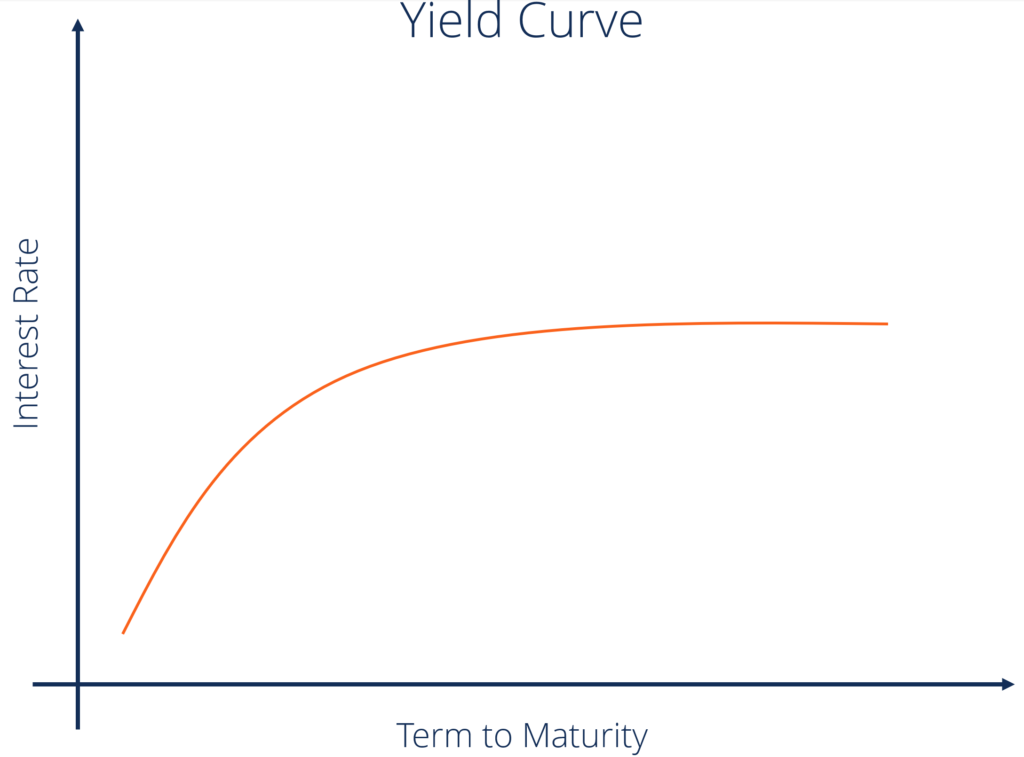
However, it is important to note that a par yield curve will be identical to market interest rates at the time, even though graphically, it may look similar to a standard yield curve.
Short-term bonds generally come with lower yields, so the curve slopes up and to the right (similar to the image above). It also occurs in the par yield curve. Generally, the par yield curve falls below the spot and forward yield curve in normal market situations.
Practical Applications
As an investor, bonds are an integral part of any portfolio you build and can serve as one of the cornerstones of your investment strategy. However, there is a risk when purchasing a bond with a long yield.
Money placed in the bond carries with it an opportunity costOpportunity CostOpportunity cost is one of the key concepts in the study of economics and is prevalent throughout various decision-making processes. The; funds can be invested in other instruments, even those that carry a guarantee on principle. As such, understanding what the par yield curve represents and how it can affect the time value of your money is critical when using Treasury bonds and the like as part of your investment portfolio and strategy.
Related Readings
CFI offers the Capital Markets & Securities Analyst (CMSA)®Program Page - CMSAEnroll in CFI's CMSA® program and become a certified Capital Markets &Securities Analyst. Advance your career with our certification programs and courses. certification program for those looking to take their careers to the next level. To keep learning and advance your career, the following resources will be helpful:
- Coupon RateCoupon RateA coupon rate is the amount of annual interest income paid to a bondholder, based on the face value of the bond.
- Discount RateDiscount RateIn corporate finance, a discount rate is the rate of return used to discount future cash flows back to their present value. This rate is often a company’s Weighted Average Cost of Capital (WACC), required rate of return, or the hurdle rate that investors expect to earn relative to the risk of the investment.
- Flat Yield CurveFlat Yield Curve A flat yield curve is a type of yield curve that occurs when anticipated interest rates are steady, or when short term volatility outweighs
- Time Value of MoneyTime Value of MoneyThe time value of money is a basic financial concept that holds that money in the present is worth more than the same sum of money to be received in the future. This is true because money that you have right now can be invested and earn a return, thus creating a larger amount of money in the future. (Also, with future
-

Understanding Movement Along the Demand Curve: A Comprehensive Guide
It is axiomatic among economists that nearly all principles in economics bear some relationship to supply and demand, be it for goods, services or labor. Both of these factors are closely linked and o
-
Understanding the Investment Accumulation Phase: Building Wealth Over Time
The accumulation phase refers to the time in the life cycle of an investment when an individual or an investor builds up the value of their annuity or investment. It is the second phase in the process
invest
- Understanding Inverted Yield Curves: Recession Indicator?
- Understanding Yield Curve Rollover: A Fixed Income Strategy
- Understanding Swap Rate Curves: A Comprehensive Guide
- Understanding the Yield Curve: Definition & Significance
- Understanding the Credit Curve: A Guide for Investors
- Understanding the Flat Yield Curve: Causes & Implications
- Understanding the Forward Curve: A Comprehensive Guide
- Understanding the Experience Curve: Cost Reduction & Efficiency
- Understanding the Economic Implications of an Inverted Treasury Yield Curve
-
 Understanding Annual Percentage Yield (APY): A Comprehensive Guide
The annual percentage yield (APY) is a normalized interest rateInterest RateAn interest rate refers to the amount charged by a lender to a borrower for any form of debt given, generally expressed as a...
-
![Yield to Maturity (YTM): Definition & Calculation | [Your Brand/Website Name]](https://www.etffin.com/article/uploadfiles/202110/2021100815185913_S.jpeg) Yield to Maturity (YTM): Definition & Calculation | [Your Brand/Website Name]
Yield to Maturity (YTM): Definition & Calculation | [Your Brand/Website Name]Yield to Maturity (YTM) – otherwise referred to as redemption or book yieldYieldYield is defined as an income-only return on investment (it excludes capital gains) calculated by taking dividends...