
Sell to Open Options: A Comprehensive Guide
Sell to open is an options trade order and refers to initiating a short option position by writing or selling an options contract. When an individual sells to open, he/she is initiating a short options position. It is useful to think of a sell to open as “opening an options contract by writing or selling.”
Understanding Sell to Open
An options contract is defined as an agreement between two parties for a potential transaction of the options contract’s underlying asset at a predetermined price (the strike priceStrike PriceThe strike price is the price at which the holder of the option can exercise the option to buy or sell an underlying security, depending on) on or before an expiration date. The two types of options are call options and put options.
Two Types of Options
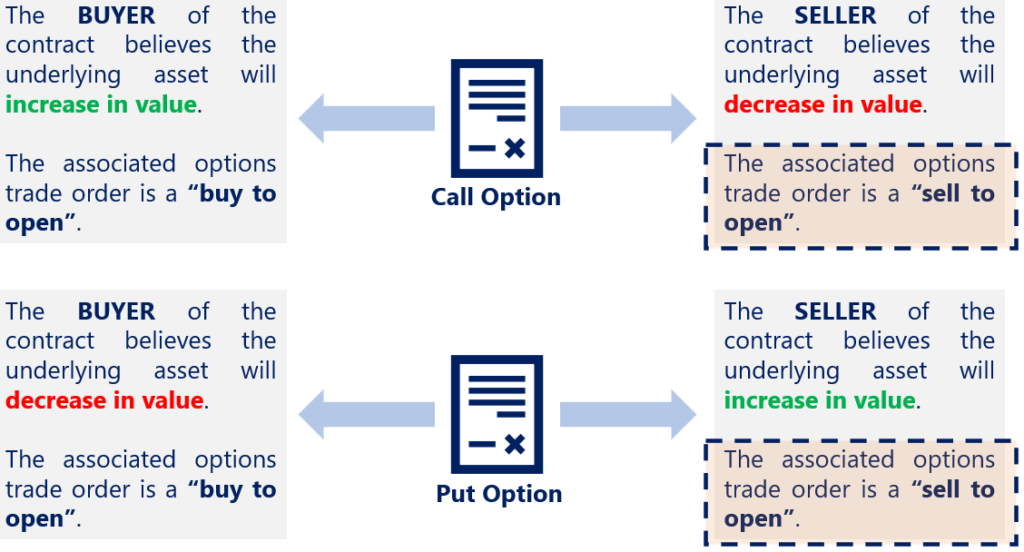
For each type of options contract, one party is long, and one party is short:
1. Call Option
The party with a long position BUYS the call option and believes that the underlying asset’s price will increase. A premium is paid for the right to purchase the underlying assetUnderlying AssetUnderlying asset is an investment term that refers to the real financial asset or security that a financial derivative is based on. Thus, the at a predetermined price (the strike price) on or before an expiration date.
The party that has a short position SELLS the call option and believes that the underlying asset’s price will decrease. As such, this party is opening an options contract by selling (sell to open) the opportunity to purchase the underlying asset at a predetermined price on or before an expiration date for a premium.
2. Put Option
The party with a long position BUYS the put option and believes that the underlying asset’s price will decrease. A premium is paid for the right to sell the underlying asset at a predetermined price (the strike price) on or before an expiration dateExpiration Date (Derivatives)The expiration date refers to the date in which options or futures contracts expire. It is the last day of the validity of the derivatives contract..
The party with a short position SELLS the put option and believes that the underlying asset’s price will increase. As such, this party is opening an options contract by selling (sell to open) the opportunity to sell the underlying asset at a predetermined price on or before an expiration date for a premium.
The following graphic illustrates sell to open:
Option Premium From Sell to Open
When a party sells to open an options contract, a premium is received. The premium reflects the current market price of the options contract. The options premium is a combination of two factors – extrinsic and intrinsic value.
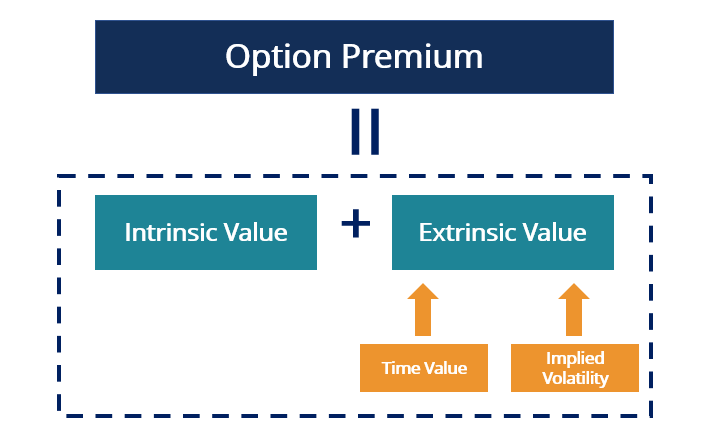
Extrinsic value is based on (1) time value – the time remaining until the option contract expires, and (2) implied volatilityImplied Volatility (IV)Implied volatility – or simply IV – uses the price of an option to calculate what the market is saying about the future volatility of the – the amount that the underlying asset may move.
- The more time until an options contract expires, the greater the time value and resulting extrinsic value. The greater the time to maturity, the greater the probability that the underlying asset will surpass the strike price.
- The more volatile the underlying asset is of an options contract, the greater the extrinsic value. Again, it is because it increases the probability that the underlying asset will surpass the strike price.
Intrinsic value reflects how much the options contract is “in the money.”
- A call option has intrinsic value when the underlying asset’s price is above the strike price.
- A put option has intrinsic value when the underlying asset’s price is below the strike price.
Example of Sell to Open and Option Premium
Question: Tim thinks that Company A’s stock price will decrease in the near future. What type of options contract and type of trade order would be appropriate to profit from this speculation?
Answer: Tim should initiate a sell to open trade order on call options of Company A.
Question: A call option comes with a strike price of $50. The underlying asset is priced at $45. However, the premium is currently $5. Where is the premium coming from?
Answer: For a call option, if the underlying asset’s price is below the strike price, there is no intrinsic value. The option premium is coming entirely from extrinsic value, namely, time value and implied volatility.
Key Takeaways
- Sell to open refers to initiating a short options position.
- The premium generated from sell to open is based on intrinsic and extrinsic values.
- When an investor sells to open a call option, he/she believes the value of the underlying asset will decrease. On the other hand, when an investor sells to open a put option, he/she believes the underlying asset’s value will increase.
Additional Resources
CFI is the official provider of the Capital Markets & Securities Analyst (CMSA)®Program Page - CMSAEnroll in CFI's CMSA® program and become a certified Capital Markets &Securities Analyst. Advance your career with our certification programs and courses. certification program, designed to transform anyone into a world-class financial analyst.
In order to help you become a world-class financial analyst and advance your career to your fullest potential, these additional resources will be very helpful:
- At the Money (ATM)At The Money (ATM)At the money (ATM) describes a situation when the strike price of an option is equal to the underlying asset's current market price. It is a concept of
- Intrinsic ValueIntrinsic ValueThe intrinsic value of a business (or any investment security) is the present value of all expected future cash flows, discounted at the appropriate discount rate. Unlike relative forms of valuation that look at comparable companies, intrinsic valuation looks only at the inherent value of a business on its own.
- Options: Calls and PutsOptions: Calls and PutsAn option is a derivative contract that gives the holder the right, but not the obligation, to buy or sell an asset by a certain date at a specified price.
- Long and Short PositionsLong and Short PositionsIn investing, long and short positions represent directional bets by investors that a security will either go up (when long) or down (when short). In the trading of assets, an investor can take two types of positions: long and short. An investor can either buy an asset (going long), or sell it (going short).
-
Understanding Digital Options: A Comprehensive Guide for Traders
A digital option is a form of option that allows traders to manually set a strike price. The digital option provides the traders with a fixed payout in the case when the market price of the underlying
-
Understanding Dirty Price: Bond Pricing Explained
Dirty price is when a bond price includes interest that has accrued since the latest coupon payment. When investors buy fixed-income securities, such as bondsBonds vs StocksFor prospective
invest
- Understanding Divergence in Technical Analysis: A Guide
- Understanding Forward Prices: Definition & How They Work
- Understanding Hedging Strategies: A Comprehensive Guide
- Understanding Max Pain in Options Trading: Risks and Strategies
- Sell to Close Options: A Comprehensive Guide for Investors
- Understanding Slippage in Trading: Causes & Impact
- Understanding Strangle Options: A Comprehensive Guide
- Understanding Volatility: A Key Indicator of Investment Risk
- Options Trading Explained: Risks & Rewards for Investors
-
 Understanding Dealer Markets: How Market Makers Function
A dealer market is a financial market where dealers post prices they would be willing to buy and sell specific securitiesTrading SecuritiesTrading securities are securities purchased by a company for ...
-
 Understanding Delta: A Key Risk Measure in Derivatives
Delta is a risk sensitivity measure used in assessing derivativesDerivativesDerivatives are financial contracts whose value is linked to the value of an underlying asset. They are complex financial in...