
Understanding the Liquidity Preference Theory: A Comprehensive Explanation
The Theory of Liquidity Preference states that agents in financial markets demonstrate a preference for liquidity. Formally, if U(Asset A) > U(Asset B) and rA = rB, then L(Asset A) > L(Asset B), where:
- U(Asset A) is an investor’s utility from holding asset A
- U(Asset B) is an investor’s utility from holding asset B
- rA is the return generated by asset A
- rB is the return generated by asset B
- L(Asset A) is the liquidity of Asset A
- L(Asset B) is the liquidity of Asset B
Under the Theory of Liquidity Preference, an investor faced with two assets offering the same rate of returnRate of ReturnThe Rate of Return (ROR) is the gain or loss of an investment over a period of time copmared to the initial cost of the investment expressed as a percentage. This guide teaches the most common formulas will always choose the more liquid asset. The term liquidity preference was introduced by English economist John Maynard Keynes in his 1936 book, “The General Theory of Employment, Interest, and Money.” Keynes called the aggregate demand for money in the economy liquidity preference.
The Keynesian Monetary Theory and the LM Curve
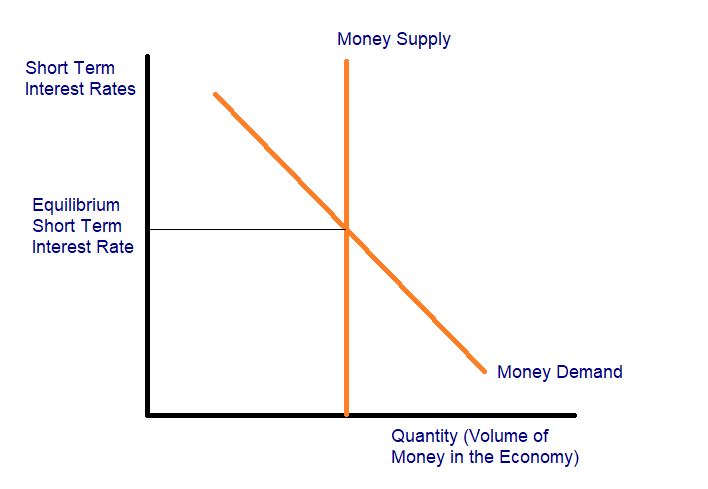
According to Keynes General Theory, the short-term interest rate is determined by the supply and demand for money. Holding money is the opportunity costOpportunity CostOpportunity cost is one of the key concepts in the study of economics and is prevalent throughout various decision-making processes. The of not investing that money in short-term bonds. The demand for money is a function of the short-term interest rate and is known as the liquidity preference function.
Money supply is usually a fixed quantity set by a central banking authorityFederal Reserve (The Fed)The Federal Reserve is the central bank of the United States and is the financial authority behind the world’s largest free market economy.. L(r,Y) is a liquidity preference function if and if , where r is the short-term interest rate and Y is the level of output in the economy.
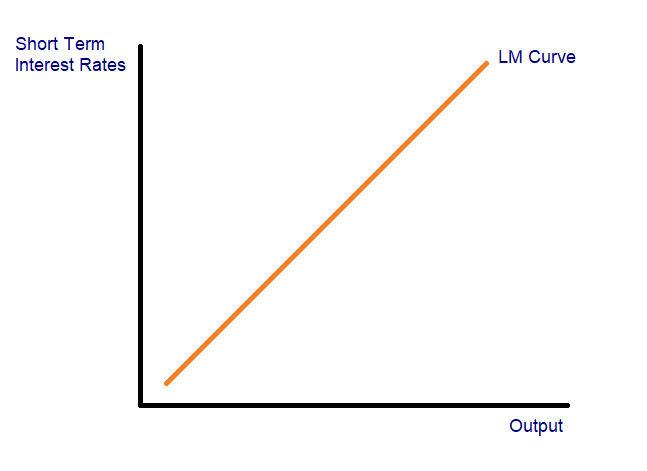
Formally, the liquidity money (LM) curve is the locus of points in Output – Interest Rate space such that the money market is in equilibrium. Alternatively, we can say that the LM curve maps changes in money demand or supply to changes in the short-term interest rateInterest RateAn interest rate refers to the amount charged by a lender to a borrower for any form of debt given, generally expressed as a percentage of the principal..
The Theory of Liquidity Preference and an Upward Sloping Yield Curve
According to the Theory of Liquidity Preference, the short-term interest rate in an economy is determined by the supply and demandSupply and DemandThe laws of supply and demand are microeconomic concepts that state that in efficient markets, the quantity supplied of a good and quantity for the most liquid asset in the economy – money. The concept, when extended to the bond market, gives a clear explanation for the upward sloping yield curve. Since investors strictly prefer liquidity, in order to persuade investors to buy long-term bonds over short-term bonds, the return offered by long-term bonds must be greater than the return offered by short-term bonds.
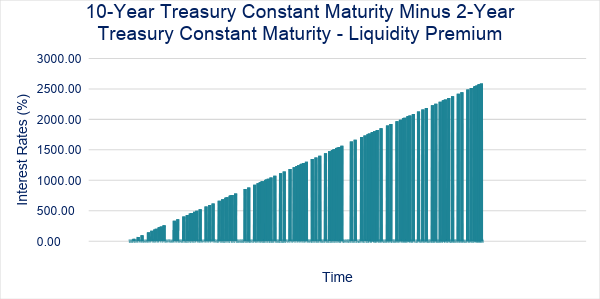
Formally, if U(Asset A) > U(Asset B), and L(Asset A) > L(Asset B), then rA > rB. The difference in interest rates is known as the liquidity premium or the term premium. A commonly used measure of the term premium is the 10-2 spread.
The Preferred Habitat Theory
The Theory of Liquidity Preference is a special case of the Preferred Habitat Theory in which the preferred habitat is the short end of the term structure. The Preferred Habitat Theory states that the market for bonds is ‘segmented’ on the basis of the bonds’ term structure, and these “segmented” markets are linked on the basis of the preferences of bond market investors.
Under the Preferred Habitat Theory, bond market investors prefer to invest in a specific part or “habitat” of the term structure. The theory was introduced by Italian-American economist Franco Modigliani and American economic historian Richard Sutch in their 1966 paper titled “Innovations in Interest Rates Policy.”
More Resources
CFI is the official provider of the Financial Modeling and Valuation Analyst (FMVA)™Become a Certified Financial Modeling & Valuation Analyst (FMVA)®CFI's Financial Modeling and Valuation Analyst (FMVA)® certification will help you gain the confidence you need in your finance career. Enroll today! certification program, designed to transform anyone into a world-class financial analyst.
To keep learning and developing your knowledge of financial analysis, we highly recommend the additional resources below:
- Inverted Yield CurveInverted Yield CurveAn inverted yield curve often indicates the lead-up to a recession or economic slowdown. The yield curve is a graphical representation of the relationship between the interest rate paid by an asset (usually government bonds) and the time to maturity.
- Investing: A Beginner’s GuideInvesting: A Beginner's GuideCFI's Investing for Beginners guide will teach you the basics of investing and how to get started. Learn about different strategies and techniques for trading
- Key Players in the Capital MarketsKey Players in the Capital MarketsIn this article, we provide a general overview of the key players and their respective roles in the capital markets. The capital markets consist of two types of markets: primary and secondary. This guide will provide an overview of all the major companies and careers across the capital markets.
- Keynesian Economic TheoryKeynesian Economic TheoryKeynesian Economic Theory is an economic school of thought that broadly states that government intervention is needed to help economies emerge
-
Understanding the Investment Accumulation Phase: Building Wealth Over Time
The accumulation phase refers to the time in the life cycle of an investment when an individual or an investor builds up the value of their annuity or investment. It is the second phase in the process
-

Asset Swap Explained: Definition, OTC Trading & Key Concepts
An asset swap is a derivative contract between two parties that swap fixed and floating assets. The transactions are done over-the-counterOver-the-Counter (OTC)Over-the-counter (OTC) is the trading of
invest
- Arbitrage Pricing Theory (APT): A Comprehensive Overview
- Darvas Box Strategy: A Beginner's Guide to Profitable Trading
- Elliott Wave Theory: A Comprehensive Guide for Traders
- Understanding the Greater Fool Theory: Market Valuation & Irrational Exuberance
- Local Expectations Theory: Understanding Bond Yields & Term Structure
- Modern Portfolio Theory (MPT): Maximize Returns, Minimize Risk
- Preferred Habitat Theory in Bond Markets: An Explanation
- Random Walk Theory Explained: Understanding Market Price Movements
- Segmented Markets Theory: Understanding Bond Term Structure
-
 Operating Asset Turnover Ratio: Definition & Analysis
The operating asset turnover ratio, an efficiency ratio, is a variation of the total asset turnover ratioAsset Turnover RatioThe asset turnover ratio, also known as the total asset turnover ratio, mea...
-
 Pecking Order Theory: Understanding Corporate Financing Strategies
The Pecking Order Theory, also known as the Pecking Order Model, relates to a company’s capital structureCapital StructureCapital structure refers to the amount of debt and/or equity employed by...