
Understanding Variable Price Limits in Futures Contracts
Variable price limits allow futures contracts to move beyond their fixed price limits in a single day. Due to the high volatility of the commoditiesCommoditiesCommodities are another class of assets just like stocks and bonds. Most commodities are products that come from the earth that possess market, price limits are imposed on future contracts to ensure a regulated market. Trading stops when contracts hit their price limits.
However, sometimes with heavy trading volumes, a variable price limit mechanism can be implemented, so that after reaching its initial fixed price limit, a futures contractFutures ContractA futures contract is an agreement to buy or sell an underlying asset at a later date for a predetermined price. It’s also known as a derivative because future contracts derive their value from an underlying asset. Investors may purchase the right to buy or sell the underlying asset at a later date for a predetermined price. can move beyond that limit in the next trading day.
Summary
- A price limit is the maximum range that a futures contract is allowed to move up or down within a single day.
- Price limits are re-calculated every day.
- When price limits are reached in one day, the variable price limits might be implemented to expand the initial limits to the variable amount for the next trading day.
What is a Price Limit?
A price limit is the maximum range that a futures contract is allowed to move up or down within a single day. It is set by the exchange to prevent excessive daily volatilities in the futures market.
When a product reaches its highest price allowed, the product is “limit up,” when it reaches the lowest price allowed, it is “limit down.” When the product is limit up or down, different actions can occur. The trading might be stopped for that single day, or the market might temporarily halt until the price limit is expanded.
According to their regulatory rules, different future contracts have different levels of price limits, as well as actions after the price hits the limits. For example, agriculture futures usually have both upside and downside limits.
Equity index futures only have limits on the downside without upside limits, plus an overnight limit up and down. Price limits are re-calculated for every trading day. Generally, agriculture futures go limit up or down more often than equity index futuresStock Index FuturesStock index futures, also referred to as equity index futures or just index futures, are futures contracts based on a stock index. Futures contracts are an do.
Price limits are subject to the rules set by exchanges. Different exchanges may implement different rules. They may also alter their rules over time. Futures contract traders must be aware of these rules and changes.
Initial Price Limit vs. Variable Price Limit
There are two parts in the price limits for some futures contracts: an initial price limit and a variable price limit (some futures contracts do not have variable price limits). Initial price limits are fixed, restricting the transactions from settling above the upper limits or below the lower limits. Variable price limits allow for higher limits when the market goes high and lower limits when the market goes low.
For products with variable price limits, when they reach the initial price limits for one day, variable price limits may be implemented in the next trading day, which expands the initial limits to the variable amounts for that day. The expanded limits will remain until there are no more contracts settled at the expanded range.
The mechanism allows the products to be traded beyond their initial price limits so that more traders can enter or exit the market. Less restriction improves market efficiency, and the prices can move back to the fair values more quickly.
Variable Price Limit – Example
A variable price limit mechanism is implemented for a lot of agriculture futures. As the diagram shows below, corn futures have two levels of limit up and down.
Level 1 gives a fixed initial limit of $0.25 per bushel, which means corn can move $0.25 up or down in that trading day from the closing price of the previous day. Level 2 is a variable price limit of $0.40 per bushel, which gives an expansion of $0.15 per bushel beyond the initial price limit.
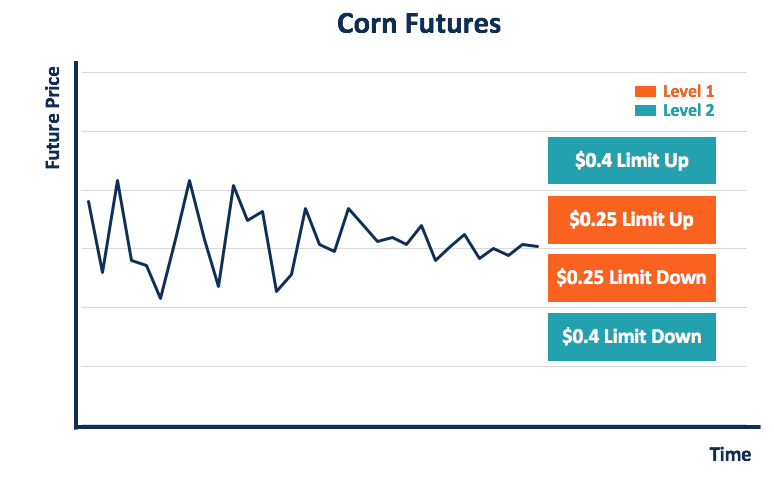
If corn closed at $3.50 in the previous trading day, it would have a limit up at $3.75 and a limit down at $3.25 today. When either of the limits is hit, the market will be temporarily closed for that day, and the price limits for the next day can be expanded for another $0.15 to $0.40.
If corn goes limit up and closes at $3.75, the limit up for the next day will be $3.75 + $0.40 = $4.15. If it goes limit down and closes at $3.25, the limit down for the next day will be $3.25 – $0.40 = $2.85.
A larger permitted price range allows the market to move back to its fair value more quickly. Once trades are not settled in the variable price limit anymore, the initial price limit is implemented again.
Additional Resources
CFI is the official provider of the global Commercial Banking & Credit Analyst (CBCA)™Program Page - CBCAGet CFI's CBCA™ certification and become a Commercial Banking & Credit Analyst. Enroll and advance your career with our certification programs and courses. certification program, designed to help anyone become a world-class financial analyst. To keep advancing your career, the additional resources below will be useful:
- Guide to Commodity TradingGuide to Commodity Trading SecretsSuccessful commodity traders know the commodity trading secrets and distinguish between trading different types of financial markets. Trading commodities is different from trading stocks.
- VolatilityVolatilityVolatility is a measure of the rate of fluctuations in the price of a security over time. It indicates the level of risk associated with the price changes of a security. Investors and traders calculate the volatility of a security to assess past variations in the prices
- Price Floors and CeilingsPrice Floors and CeilingsPrice floors and price ceilings are government-imposed minimums and maximums on the price of certain goods or services. It is usually done to
- Spot PriceSpot PriceThe spot price is the current market price of a security, currency, or commodity available to be bought/sold for immediate settlement. In other words, it is the price at which the sellers and buyers value an asset right now.
-
Understanding Dirty Price: Bond Pricing Explained
Dirty price is when a bond price includes interest that has accrued since the latest coupon payment. When investors buy fixed-income securities, such as bondsBonds vs StocksFor prospective
-
Understanding Exercise Price in Options Trading
The exercise price within an option is the price at which the holder is capable of purchasing the underlying asset. If the market price of the asset is above the exercise price, the holder is capable
invest
- Limit Orders: A Comprehensive Guide for Investors
- Understanding Limit Moves in Commodity Futures Contracts
- Understanding Daily Trading Limits: A Comprehensive Guide
- Understanding Divergence in Technical Analysis: A Guide
- Understanding Forward Prices: Definition & How They Work
- Understanding Hedging Strategies: A Comprehensive Guide
- Understanding Slippage in Trading: Causes & Impact
- Understanding Strangle Options: A Comprehensive Guide
- Understanding Volatility: A Key Indicator of Investment Risk
-
 Understanding Delta: A Key Risk Measure in Derivatives
Delta is a risk sensitivity measure used in assessing derivativesDerivativesDerivatives are financial contracts whose value is linked to the value of an underlying asset. They are complex financial in...
-
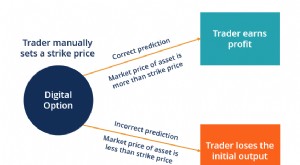 Understanding Digital Options: A Comprehensive Guide for Traders
A digital option is a form of option that allows traders to manually set a strike price. The digital option provides the traders with a fixed payout in the case when the market price of the underlying...