
Cash Conversion Cycle (CCC): Definition & Analysis
The Cash Conversion Cycle (CCC) is a metric that shows the amount of time it takes a company to convert its investments in inventoryInventoryInventory is a current asset account found on the balance sheet, consisting of all raw materials, work-in-progress, and finished goods that a to cash. The conversion cycle formula measures the amount of time, in days, it takes for a company to turn its resource inputs into cash. Learn more in CFI’s Financial Analysis Fundamentals Course.
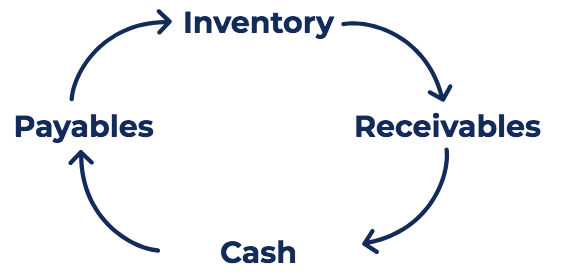
Cash Conversion Cycle Formula
The cash conversion cycle formula is as follows:
Cash Conversion Cycle = DIO + DSO – DPO
Where:
- DIO stands for Days Inventory Outstanding
- DSO stands for Days Sales Outstanding
- DPO stands for Days Payable Outstanding
What is Days Inventory Outstanding (DIO)?
Days Inventory Outstanding (DIO)Days Inventory OutstandingDays inventory outstanding (DIO) is the average number of days that a company holds its inventory before selling it. The days inventory is the number of days, on average, it takes a company to turn its inventory into sales. Essentially, DIO is the average number of days that a company holds its inventory before selling it. The formula for days inventory outstanding is as follows:

For example, Company A reported a $1,000 beginning inventory and $3,000 ending inventory for the fiscal year ended 2018 with $40,000 cost of goods sold. The DIO for Company A would be:

Therefore, it takes this company approximately 18 days to turn its inventory into sales.
Days Sales Outstanding (DSO)
Days Sales Outstanding (DSO)Days Sales Outstanding (DSO)Days Sales Outstanding (DSO) represents the average number of days it takes credit sales to be converted into cash, or how long it takes a is the number of days, on average, it takes a company to collect its receivables. Therefore, DSO measures the average number of days for a company to collect payment after a sale. The formula for days sales outstanding is as follows:

For example, Company A reported $4,000 in beginning accounts receivable and $6,000 in ending accounts receivable for the fiscal year ended 2018, along with credit sales of $120,000. The DSO for Company A would be:

Therefore, it takes this company approximately 15 days to collect a typical invoice.
What is Days Payable Outstanding (DPO)?
Days Payable Outstanding (DPO)Days Payable OutstandingDays payable outstanding (DPO) refers to the average number of days it takes a company to pay back its accounts payable. Therefore, days is the number of days, on average, it takes a company to pay back its payables. Therefore, DPO measures the average number of days for a company to pay its invoices from trade creditors, i.e., suppliers. The formula for days payable outstanding is as follows:

For example, Company A posted $1,000 in beginning accounts payable and $2,000 in ending accounts payable for the fiscal year ended 2018, along with $40,000 in cost of goods sold. The DSO for Company A would be:

Therefore, it takes this company approximately 13 days to pay for its invoices.
Learn more in CFI’s Financial Analysis Fundamentals Course.
Putting it Together: Cash Conversion Cycle
Recall that the Cash Conversion Cycle Formula = DIO + DSO – DPO. How do we interpret it?
We can break the cash cycle into three distinct parts: (1) DIO, (2) DSO, and (3) DPO. The first part, using days inventory outstanding, measures how long it will take the company to sell its inventory. The second part, using days sales outstanding, measures the amount of time it takes to collect cash from these sales.
The last part, using days payable outstanding, measures the amount of time it takes for the company to pay off its suppliers. Therefore, the cash conversion cycle is a cycle where the company purchases inventory, sells the inventory on credit, and collects the accounts receivable and turns them into cash.
Using the DIO, DSO, and DPO for Company A above, we find that our cash conversion cycle for Company A is:
CCC = 18.25 + 15.20 – 13.69 = 19.76
Therefore, it takes Company A approximately 20 days to turn its initial cash investment in inventory back into cash.
Interpreting the Cash Conversion Cycle
The cash conversion cycle formula is aimed at assessing how efficiently a company is managing its working capital. As with other cash flow calculations, the shorter the cash conversion cycle, the better the company is at selling inventories and recovering cash from these sales while paying suppliers.
The cash conversion cycle should be compared to companies operating in the same industry and conducted on a trend. For example, measuring a company’s conversion cycle to its cycles in previous years can help with gauging whether its working capital management is deteriorating or improving. In addition, comparing the cycle of a company to its competitors can help with determining whether the company’s cash conversion cycle is “normal” compared to industry competitors.
Related Readings
CFI offers the Financial Modeling & Valuation Analyst (FMVA)®Become a Certified Financial Modeling & Valuation Analyst (FMVA)®CFI's Financial Modeling and Valuation Analyst (FMVA)® certification will help you gain the confidence you need in your finance career. Enroll today! certification program for those looking to take their careers to the next level. To keep learning and advancing your career, the following CFI resources will be helpful:
- Analysis of Financial StatementsAnalysis of Financial StatementsHow to perform Analysis of Financial Statements. This guide will teach you to perform financial statement analysis of the income statement,
- Comparable Company AnalysisComparable Company AnalysisThis guide shows you step-by-step how to build comparable company analysis ("Comps") and includes a free template and many examples.
- Guide to Financial ModelingFinancial Modeling GuidelinesFinancial modeling guidelines are a set of best practices to follow when building a model. See CFI’s financial modeling courses for all the primary guidelines.
- Sales and Collection CycleSales and Collection CycleThe Sales and Collection Cycle, also known as the revenue, receivables, and receipts (RRR) cycle, is comprised of various classes of
-

Cash Reserves: Definition, Benefits & Short-Term Needs
Cash reserves are funds that companies set aside for use in emergency situations. The cash that is saved is used to cover costs or expenses that are unplanned or unexpected. In most cases, the reserve
-

Understanding the Earnings Multiplier (P/E Ratio): A Comprehensive Guide
The earnings multiplier, or the price-to-earnings ratio, is a method used to compare a company’s current share price to its earnings per share (EPS)Earnings Per Share (EPS)Earnings per share (EP
Accounting
- Cash Conversion Ratio (CCR): Definition & Importance
- Modigliani-Miller Theorem: Understanding Capital Structure & Firm Value
- Net Cash: Definition, Calculation & Importance for Businesses
- Understanding the Accounting Cycle: A Comprehensive Guide
- Accounts Receivable (AR): Definition, Management & Forecasting
- Direct Method for Cash Flow Statements: A Comprehensive Guide
- Understanding the Matching Principle in Accounting
- Understanding the Accounting Reporting Cycle: A Comprehensive Guide
- Cash Conversion Cycle: A Small Business Guide to Improving Liquidity
-
 Acid-Test Ratio: Understanding Your Company's Short-Term Liquidity
The Acid-Test Ratio, also known as the quick ratioQuick RatioThe Quick Ratio, also known as the Acid-test, measures the ability of a business to pay its short-term liabilities with assets readily conv...
-
 Cash Conversion Cycle (CCC): Definition & Analysis
The Cash Conversion Cycle (CCC) is a metric that shows the amount of time it takes a company to convert its investments in inventoryInventoryInventory is a current asset account found on the balance s...