
Capital Adequacy Ratio (CAR): Understanding Bank Financial Health
The Capital Adequacy Ratio set standards for banksBanking (Sell-Side) CareersThe banks, also known as Dealers or collectively as the Sell-Side, offer a wide range of roles like investment banking, equity research, sales & trading by looking at a bank’s ability to pay liabilities, and respond to credit risks and operational risks. A bank that has a good CAR has enough capital to absorb potential losses. Thus, it has less risk of becoming insolventInsolvencyInsolvency refers to the situation in which a firm or individual is unable to meet financial obligations to creditors as debts become due. Insolvency is a state of financial distress, whereas bankruptcy is a legal proceeding. and losing depositors’ money. After the financial crisis in 2008, the Bank of International Settlements (BIS) Bank for International Settlements (BIS)The Bank for International Settlements (BIS) started in 1930, and is owned by the central banks of different countries. It serves as a bank for member central banks, and its role is to foster international monetary, financial stability and financial corporation. The Bank for International Settlements is based inbegan setting stricter CAR requirements to protect depositors.

Summary
- The Capital Adequacy Ratio (CAR) helps make sure banks have enough capital to protect depositors’ money.
- The formula for CAR is: (Tier 1 Capital + Tier 2 Capital) / Risk-Weighted Assets
- Capital requirements set by the BIS have become more strict in recent years.
What is the Capital Adequacy Ratio Formula?
As shown below, the CAR formula is:

CAR = (Tier 1 Capital + Tier 2 Capital) / Risk-Weighted Assets
The Bank of International Settlements separates capital into Tier 1 and Tier 2 based on the function and quality of the capital. Tier 1 capital is the primary way to measure a bank’s financial health. It includes shareholder’s equityOwner’s EquityOwner's Equity is defined as the proportion of the total value of a company’s assets that can be claimed by the owners (sole proprietorship or partnership) and by the shareholders (if it is a corporation). It is calculated by deducting all liabilities from the total value of an asset (Equity = Assets – Liabilities). and retained earningsRetained EarningsThe Retained Earnings formula represents all accumulated net income netted by all dividends paid to shareholders. Retained Earnings are part, which are disclosed on financial statements.
As it is the core capital held in reserves, Tier 1 capital is capable of absorbing losses without impacting business operations. On the other hand, Tier 2 capital includes revalued reserves, undisclosed reserves, and hybrid securities. Since this type of capital has lower quality, is less liquid, and is more difficult to measure, it is known as supplementary capital.
The bottom half of the equation is risk-weighted assets. Risk-weighted assets are the sum of a bank’s assets, weighted by risk. Banks usually have different classes of assets, such as cash, debenturesDebentureA Debenture is an unsecured debt or bonds that repay a specified amount of money plus interest to the bondholders at maturity. A debenture is a long-term debt instrument issued by corporations and governments to secure fresh funds or capital. Coupons or interest rates are offered as compensation to the lender., and bondsBondsBonds are fixed-income securities that are issued by corporations and governments to raise capital. The bond issuer borrows capital from the bondholder and makes fixed payments to them at a fixed (or variable) interest rate for a specified period., and each class of asset is associated with a different level of risk. Risk weighting is decided based on the likelihood of an asset to decrease in value.
Asset classes that are safe, such as government debt, have a risk weighting close to 0%. Other assets backed by little or no collateralCollateralCollateral is an asset or property that an individual or entity offers to a lender as security for a loan. It is used as a way to obtain a loan, acting as a protection against potential loss for the lender should the borrower default in his payments., such as a debenture, have a higher risk weighting. This is because there is a higher likelihood the bank may not be able to collect the loan. Different risk weighting can also be applied to the same asset class. For example, if a bank has lent money to three different companies, the loans can have different risk weighting based on the ability of each company to pay back its loan.
Calculating the Capital Adequacy Ratio (CAR) – Worked Example
Let us look at an example of Bank A. Below is the information of Bank A’s Tier 1 and 2 Capital, and the risks associated with their assets.

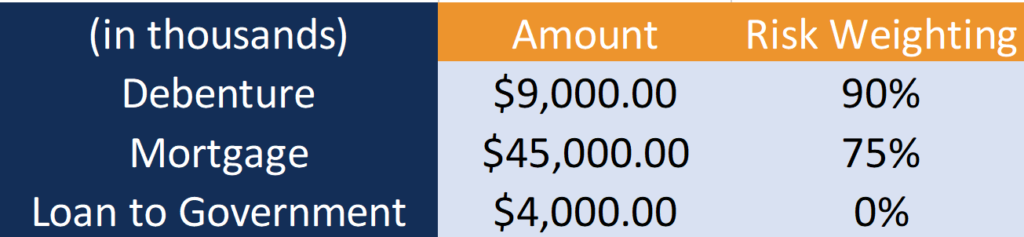
Bank A has three types of assets: Debenture, Mortgage, and Loan to the Government. To calculate the risk-weighted assets, the first step is to multiply the amount of each asset by the corresponding risk weighting:
- Debenture: $9,000 * 90% = $8,100
- Mortgage: $45,000 * 75% = $33,750
- Loan to Government: $4,000 * 0% = $0
As the loan to the government carries no risk, it contributes $0 to the risk-weighted assets.
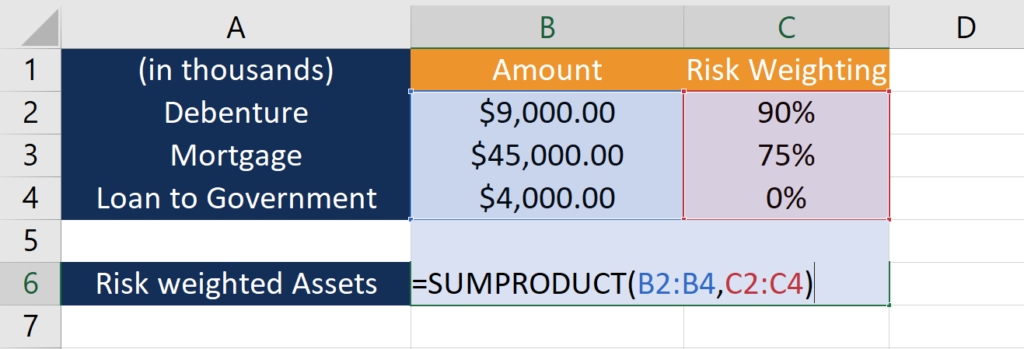
The second step is to add the risk-weighted assets to arrive at the total:
- Risk-Weighted Assets: $8,100 + $33,750 + $0 = $41,850
The calculation can be easily done on Excel using the SUMPRODUCTSUMPRODUCTThe SUMPRODUCT Function is categorized under Excel Math and Trigonometry functions. The function will multiply the corresponding components of a given array and then return the sum of the products. SUMPRODUCT is a very handy formula as it can handle arrays in different ways and help in comparing data function.
To learn more about Excel functions, take a look at CFI’s free Excel course.
The Capital Adequacy Ratio of Bank A is as follows :
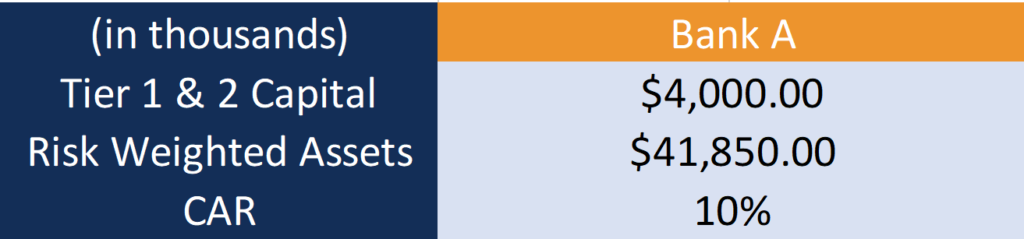
Where:
- CAR : $4,000 / $41,850 = 10%
As Bank A has a CAR of 10%, it has enough capital to cushion potential losses and protect depositors’ money.
What are the Requirements?
Under Basel IIIBasel IIIThe Basel III accord is a set of financial reforms that was developed by the Basel Committee on Banking Supervision (BCBS), with the aim of strengthening, all banks are required to have a Capital Adequacy Ratio of at least 8%. Since Tier 1 Capital is more important, banks are also required to have a minimum amount of this type of capital. Under Basel III, Tier 1 Capital divided by Risk-Weighted Assets needs to be at least 6%.
Additional Resources
CFI offers the Financial Modeling & Valuation Analyst (FMVA)®Become a Certified Financial Modeling & Valuation Analyst (FMVA)®CFI's Financial Modeling and Valuation Analyst (FMVA)® certification will help you gain the confidence you need in your finance career. Enroll today! certification program for those looking to take their careers to the next level. To keep learning and advancing your career, the following CFI resources will be helpful:
- Bank Run Bank RunA bank run occurs when customers withdraw all their money simultaneously from their deposit accounts with a banking institution for fear that the bank
- Financial Statement for BanksFinancial Statements for BanksFinancial Statements for Banks differ from those of non-banks in that banks use much more leverage than other businesses and earn a spread
- Financial Intermediary Financial IntermediaryA financial intermediary refers to an institution that acts as a middleman between two parties in order to facilitate a financial transaction. The institutions that are commonly referred to as financial intermediaries include commercial banks, investment banks, mutual funds, and pension funds.
- Capital Adequacy Ratio Calculator
-
![Shareholder Equity Ratio: Definition & Calculation | [Your Company Name]](https://www.etffin.com/article/uploadfiles/202110/2021100815180064_S.png)
Shareholder Equity Ratio: Definition & Calculation | [Your Company Name]
The shareholder equity ratio is a ratio that shows the amount of a company’s assets that have been financed using the owner’s equity instead of debt. It shows the portion of shareholders&r
-
Treynor Ratio: Understanding Risk-Adjusted Portfolio Performance
The Treynor Ratio is a portfolio performance measure that adjusts for systematic riskSystematic RiskSystematic risk is that part of the total risk that is caused by factors beyond the control of a spe
finance
- Basel III Capital Adequacy Ratio: Minimum Requirements Explained
- Acid-Test Ratio: Understanding Your Company's Short-Term Liquidity
- Advertising to Sales Ratio: Measuring Ad Effectiveness & ROI
- Current Ratio: Definition, Calculation & Financial Health
- Operating Ratio: Definition, Calculation & Importance
- Quick Ratio: Understanding Your Business's Short-Term Liquidity
- Reserve Ratio Explained: Understanding Bank Reserves
- Understanding the Retention Ratio: Reinvesting for Growth
- Sharpe Ratio: Calculate & Interpret Investment Performance
-
 Inventory Turnover Ratio: Definition & Calculation
The inventory turnover ratio, also known as the stock turnover ratio, is an efficiency ratio that measures how efficiently inventoryInventoryInventory is a current asset account found on the bala...
-
 Loan-to-Value (LTV) Ratio: Understanding Risk & Home Equity
The loan-to-value (LTV) ratio is a financial ratio that compares the size of a loan to the value of an asset that is purchased using the proceeds of the loan. The LTV ratio is an important metric that...