
Interest Coverage Ratio (ICR): Definition & Importance
The Interest Coverage Ratio (ICR) is a financial ratio that is used to determine how well a company can pay the interest on its outstanding debtsSenior and Subordinated DebtIn order to understand senior and subordinated debt, we must first review the capital stack. Capital stack ranks the priority of different sources of financing. Senior and subordinated debt refer to their rank in a company's capital stack. In the event of a liquidation, senior debt is paid out first. The ICR is commonly used by lendersTop Banks in the USAAccording to the US Federal Deposit Insurance Corporation, there were 6,799 FDIC-insured commercial banks in the USA as of February 2014. , creditors, and investors to determine the riskiness of lending capital to a company. The interest coverage ratio is also called the “times interest earned” ratio.
Interest Coverage Ratio Formula
The interest coverage ratio formula is calculated as follows:

Where:
- EBITEBIT GuideEBIT stands for Earnings Before Interest and Taxes and is one of the last subtotals in the income statement before net income. EBIT is also sometimes referred to as operating income and is called this because it's found by deducting all operating expenses (production and non-production costs) from sales revenue. is the company’s operating profit (Earnings Before Interest and Taxes)
- Interest expenseInterest ExpenseInterest expense arises out of a company that finances through debt or capital leases. Interest is found in the income statement, but can also represents the interest payable on any borrowings such as bonds, loans, lines of credit, etc.
Another variation of the formula is using earnings before interest, taxes, depreciation and amortization (EBITDA) as the numerator:
Interest Coverage Ratio = EBITDA / Interest Expense
Interest Coverage Ratio Example
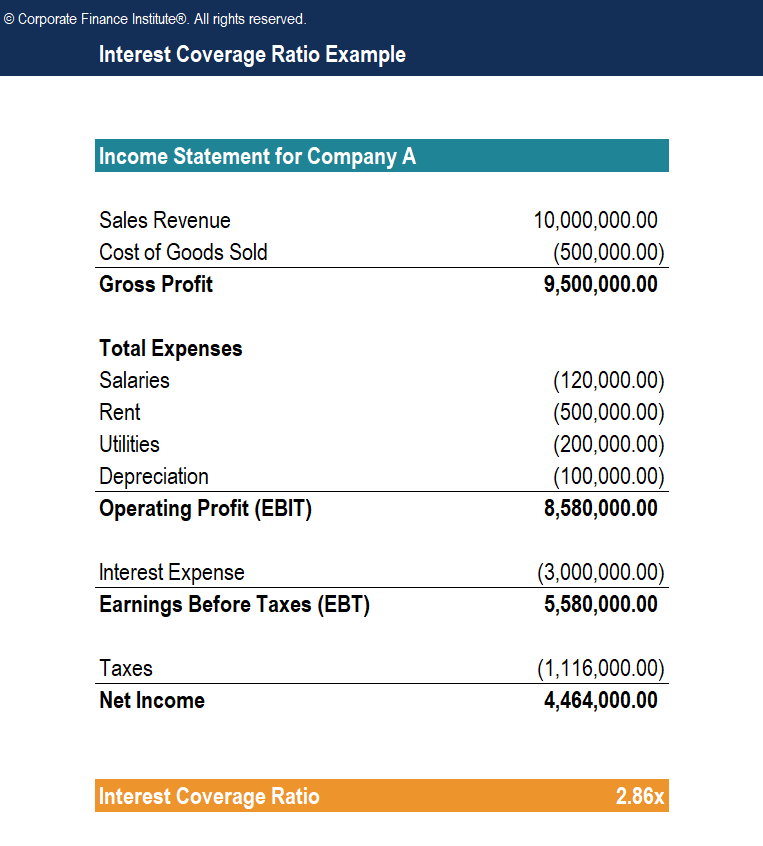
For example, Company A reported total revenues of $10,000,000 with COGS (costs of goods sold)Cost of Goods Sold (COGS)Cost of Goods Sold (COGS) measures the “direct cost” incurred in the production of any goods or services. It includes material cost, direct of $500,000. In addition, operating expenses in the most recent reporting period were $120,000 in salaries, $500,000 in rent, $200,000 in utilities, and $100,000 in depreciation. The interest expense for the period is $3,000,000. The income statement of Company A is provided below:
To determine the interest coverage ratio:
EBIT = Revenue – COGS – Operating Expenses
EBIT = $10,000,000 – $500,000 – $120,000 – $500,000 – $200,000 – $100,000 = $8,580,000
Therefore:
Interest Coverage Ratio = $8,580,000 / $3,000,000 = 2.86x
Company A can pay its interest payments 2.86 times with its operating profit.
Download the Free Template
Enter your name and email in the form below and download the free template now!
Interpretation of Interest Coverage Ratio
The lower the interest coverage ratio, the greater the company’s debt and the possibility of bankruptcyBankruptcyBankruptcy is the legal status of a human or a non-human entity (a firm or a government agency) that is unable to repay its outstanding debts. Intuitively, a lower ratio indicates that less operating profits are available to meet interest payments and that the company is more vulnerable to volatile interest rates. Therefore, a higher interest coverage ratio indicates stronger financial health – the company is more capable of meeting interest obligations.
However, a high ratio may also indicate that a company is overlooking opportunities to magnify their earnings through leverage. As a rule of thumb, an ICR above 2 would be barely acceptable for companies with consistent revenues and cash flows. In some cases, analysts would like to see an ICR above 3. An ICR lower than 1 implies poor financial health, as it shows that the company cannot pay off its short-term interest obligations.
Primary Uses of Interest Coverage Ratio
- ICR is used to determine the ability of a company to pay its interest expense on outstanding debt.
- ICR is used by lenders, creditors, and investors to determine the riskiness of lending money to the company.
- ICR is used to determine company stability – a declining ICR is an indication that a company may be unable to meet its debt obligations in the future.
- ICR is used to determine the short-term financial health of a company.
- Trend analysis of ICR gives a clear picture of the stability of a company in regard to interest payments.
For example, let us use the concept of interest coverage ratio to compare two companies:


When comparing the ICR’s of both Company A and B over a period of five years, we can see that Company A steadily increased its ICR and appears to be more stable, while Company B showed a decreasing ICR and might face liquidity issues in the future.
Additional Resources
CFI is a global provider of financial analyst training and career advancement for finance professionals, including the Financial Modeling & Valuation Analyst (FMVA)™Become a Certified Financial Modeling & Valuation Analyst (FMVA)®CFI's Financial Modeling and Valuation Analyst (FMVA)® certification will help you gain the confidence you need in your finance career. Enroll today! certification program. To learn more and expand your career, check out the additional relevant CFI resources below.
- Interest ExpenseInterest ExpenseInterest expense arises out of a company that finances through debt or capital leases. Interest is found in the income statement, but can also
- Effective Annual Interest ExpenseEffective Annual Interest RateThe Effective Annual Interest Rate (EAR) is the interest rate that is adjusted for compounding over a given period. Simply put, the effective
- Cost of DebtCost of DebtThe cost of debt is the return that a company provides to its debtholders and creditors. Cost of debt is used in WACC calculations for valuation analysis.
- Debt ScheduleDebt ScheduleA debt schedule lays out all of the debt a business has in a schedule based on its maturity and interest rate. In financial modeling, interest expense flows
-
Accrued vs. Regular Interest: Understanding the Difference
When investing in stocks and bonds, investors are paid either an accrued interest vs regular interest at an agreed period. The interest payments are not paid immediately, and security issuers will owe
-

Assumable Mortgages: A Comprehensive Guide
An assumable mortgage is a mortgage that can be transferred from the current owner of the property to the buyer, with the terms that were agreed upon originally. In other words, the buyer is able to &
finance
- Asset Coverage Ratio: Understanding Financial Solvency
- Coverage Ratio: Understanding Your Company's Debt Repayment Ability
- Debt Service Coverage Ratio (DSCR): Definition & Calculation
- Dividend Coverage Ratio (DCR): Understanding Financial Health
- Fixed-Charge Coverage Ratio (FCCR): Definition & Importance
- Interest Coverage Ratio (ICR): Definition & Importance
- Times Interest Earned (TIE) Ratio: Calculation & Interpretation
- Short Interest Ratio: Understanding Investor Sentiment & Market Risk
- Interest Coverage Ratio: Calculation & Financial Health Indicator
-
 Times Interest Earned Ratio (Cash Basis): Calculation & Interpretation
The Times Interest Earned (Cash Basis) (TIE-CB) ratio is very similar to the Times Interest Earned RatioTimes Interest EarnedThe Times Interest Earned (TIE) ratio measures a companys ability to meet i...
-
 Understanding the CDS Payout Ratio: A Comprehensive Guide
The CDS Payout Ratio is the proportion of the insured amount that the holder of the credit default swapCredit Default SwapA credit default swap (CDS) is a type of credit derivative that provides the b...