
Goodwill to Assets Ratio: Definition & Analysis
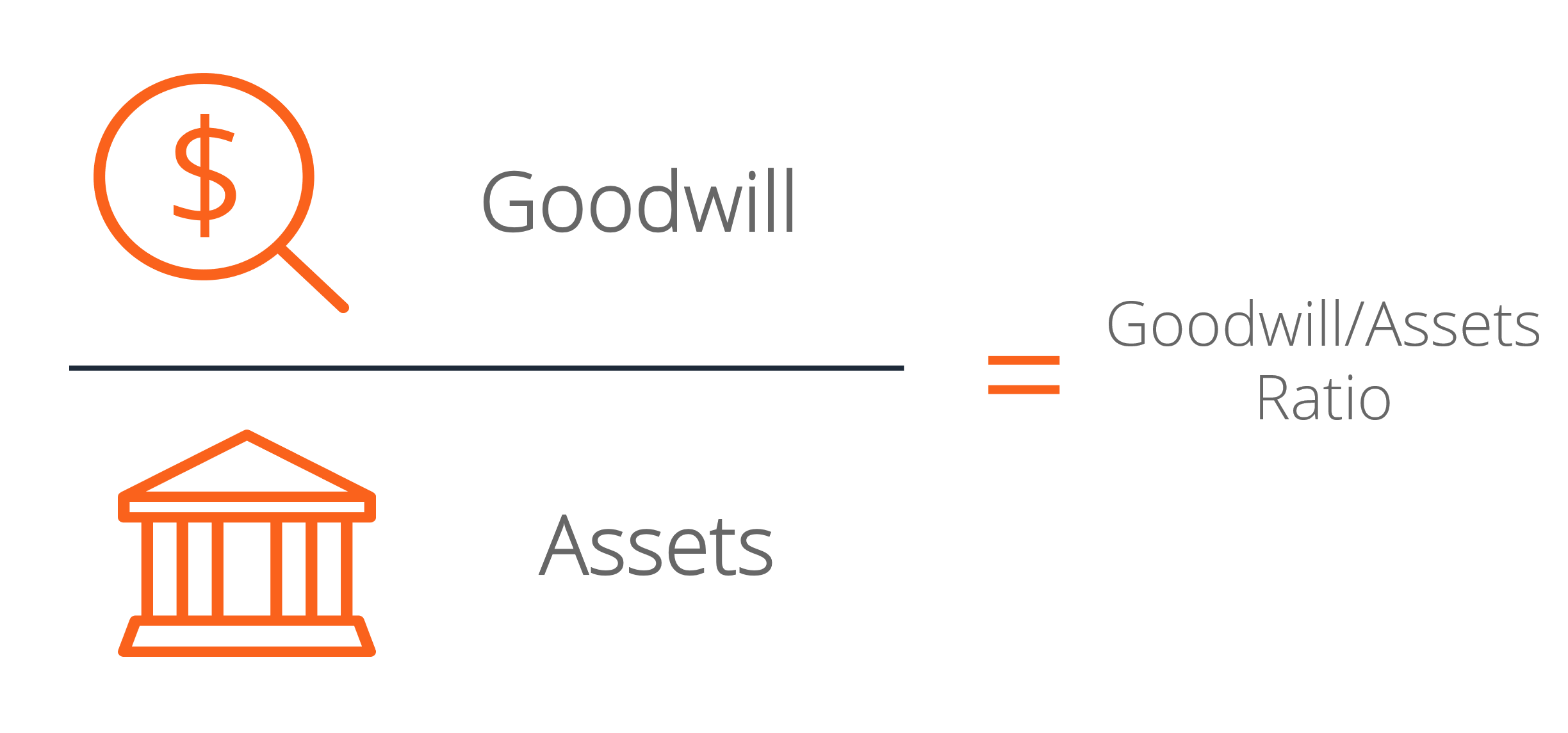
The goodwill to assets ratio measures the amount of goodwill a company has recorded on its books compared to its total assetsTypes of AssetsCommon types of assets include current, non-current, physical, intangible, operating, and non-operating. Correctly identifying and. Therefore, the goodwill/assets ratio is used to determine what portion of a company’s assets are classified as intangible assetsIntangible AssetsAccording to the IFRS, intangible assets are identifiable, non-monetary assets without physical substance. Like all assets, intangible assets versus its tangible assets.
What is Goodwill?
Goodwill is an intangible asset that arises when a firm purchases another firm at a premium value. Under accounting standards such as US GAAP and IFRS StandardsGAAPGAAP, Generally Accepted Accounting Principles, is a recognized set of rules and procedures that govern corporate accounting and financial, goodwill need not be amortized but needs to be evaluated for impairment yearly.
It is important to note that goodwill cannot be generated internally – IFRS 38 does not allow recognizing internally generated goodwill. Therefore, goodwill is only generated through purchasing other firms and is determined as the excess purchase price over the acquiree’s book value.
Goodwill = Liabilities – Assets + Purchase Price
For example, consider a firm purchasing another company for $250,000. The acquiree owns total assets of $360,000 and liabilitiesCurrent LiabilitiesCurrent liabilities are financial obligations of a business entity that are due and payable within a year. A company shows these on the of $150,000, resulting in net assets of $210,000. Therefore, the goodwill generated in this purchase would be:
Goodwill = $150,000 – $360,000 + $250,000 = $40,000
Goodwill to Assets Ratio Formula
The goodwill/assets ratio formula is as follows:

Example of the Goodwill to Assets Ratio
Company B’s owner is looking to sell their company to a purchaser, Company A, and is asking for $100 million. Company B is a strong player in the semiconductor industry, with a strong brand reputationBrand EquityIn marketing, brand equity refers to the value of a brand and is determined by the consumer’s perception of the brand. Brand equity can be positive or, customer lists, and a strong market position.
Company A understands that they would be paying a premium for Company B and therefore wants to determine approximately how much of the purchase price would go towards paying for goodwill. Company B’s book value, according to their most recent financial statements, is $80 million with zero debt on the books.
In the transaction above, we are given the following information:
- Sale price: $100 million
- Total assets: $80 million
- Unamortized goodwill: $100 million – $80 million = $20 million
Plugging in the information to the goodwill to assets formula:

The resulting ratio indicates that 20% of Company B’s valuation comes from its goodwill. Therefore, for the purchase price of $100 million, 20% of it would go towards paying for goodwill.
Interpretation of the Goodwill to Assets Ratio
The goodwill to total assets ratio presents a better idea of a company’s financial standing. To reiterate, the ratio measures the amount of goodwill that a company owns in relation to its total assets. The higher the ratio, the higher a company’s proportion of goodwill is to total assets.
- A smaller ratio indicates that a significant portion of a firm’s total assets is comprised of tangible assets – physical assets that can be sold for monetary value.
- A larger ratio indicates that a smaller portion of a firm’s total assets is comprised of tangible assets. In such a case, the valuation of a firm with a large amount of goodwill can swing heavily if the firm’s goodwill is written down.
As with other financial ratios, a suitable goodwill/assets ratio varies by industry – it is ideal to compare ratios within industries and on a trended basis.
Additional Resources
CFI is the official provider of the global Financial Modeling & Valuation Analyst (FMVA)™Become a Certified Financial Modeling & Valuation Analyst (FMVA)®CFI's Financial Modeling and Valuation Analyst (FMVA)® certification will help you gain the confidence you need in your finance career. Enroll today! certification program, designed to help anyone become a world-class financial analyst. To keep advancing your career, the additional CFI resources below will be useful:
- Cost of DebtCost of DebtThe cost of debt is the return that a company provides to its debtholders and creditors. Cost of debt is used in WACC calculations for valuation analysis.
- Financial RatiosFinancial RatiosFinancial ratios are created with the use of numerical values taken from financial statements to gain meaningful information about a company
- Goodwill Impairment AccountingGoodwill Impairment AccountingGoodwill is acquired and recorded on the books when an entity purchases another entity for more than the fair market value of its assets.
- Types of AssetsTypes of AssetsCommon types of assets include current, non-current, physical, intangible, operating, and non-operating. Correctly identifying and
-

Understanding Asset Sales: Definitions, Tax Implications, and Business Strategies
What Is the Meaning of Sale of Assets Most businesses have a variety of assets, including real estate, equipment and supplies. Individual asset disposal or sale may take place as part of norm
-
Treynor Ratio: Understanding Risk-Adjusted Portfolio Performance
The Treynor Ratio is a portfolio performance measure that adjusts for systematic riskSystematic RiskSystematic risk is that part of the total risk that is caused by factors beyond the control of a spe
finance
- Acid-Test Ratio: Understanding Your Company's Short-Term Liquidity
- Current Ratio: Definition, Calculation & Financial Health
- Debt-to-Assets Ratio: Definition, Calculation & Risk Assessment
- Operating Asset Turnover Ratio: Definition & Analysis
- Operating Ratio: Definition, Calculation & Importance
- Quick Ratio: Understanding Your Business's Short-Term Liquidity
- Reserve Ratio Explained: Understanding Bank Reserves
- Understanding the Retention Ratio: Reinvesting for Growth
- Sharpe Ratio: Calculate & Interpret Investment Performance
-
 Loan-to-Value (LTV) Ratio: Understanding Risk & Home Equity
The loan-to-value (LTV) ratio is a financial ratio that compares the size of a loan to the value of an asset that is purchased using the proceeds of the loan. The LTV ratio is an important metric that...
-
![Shareholder Equity Ratio: Definition & Calculation | [Your Company Name]](https://www.etffin.com/article/uploadfiles/202110/2021100815180064_S.png) Shareholder Equity Ratio: Definition & Calculation | [Your Company Name]
Shareholder Equity Ratio: Definition & Calculation | [Your Company Name]The shareholder equity ratio is a ratio that shows the amount of a company’s assets that have been financed using the owner’s equity instead of debt. It shows the portion of shareholders&r...