
Times Interest Earned (TIE) Ratio: Calculation & Interpretation
The Times Interest Earned (TIE) ratio measures a company’s ability to meet its debt obligations on a periodic basis. This ratio can be calculated by dividing a company’s EBITEBIT GuideEBIT stands for Earnings Before Interest and Taxes and is one of the last subtotals in the income statement before net income. EBIT is also sometimes referred to as operating income and is called this because it's found by deducting all operating expenses (production and non-production costs) from sales revenue. by its periodic interest expenseInterest ExpenseInterest expense arises out of a company that finances through debt or capital leases. Interest is found in the income statement, but can also. The ratio shows the number of times that a company could, theoretically, pay its periodic interest expenses should it devote all of its EBIT to debt repayment.
The TIE’s main purpose is to help quantify a company’s probability of default. This, in turn, helps determine relevant debt parameters such as the appropriate interest rate to be charged or the amount of debtDebt CapacityDebt capacity refers to the total amount of debt a business can incur and repay according to the terms of the debt agreement. that a company can safely take on.
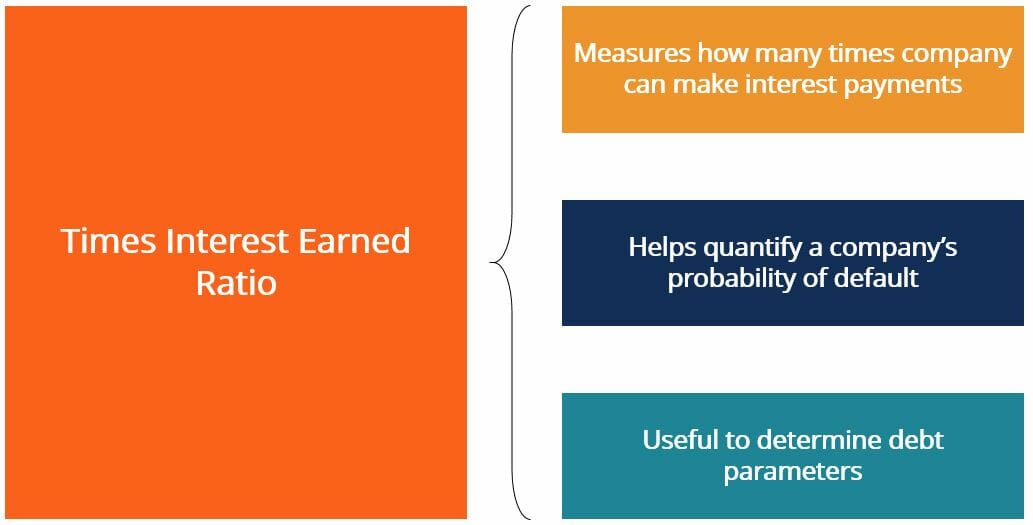
A high TIE means that a company likely has a lower probability of defaulting on its loans, making it a safer investment opportunity for debt providers. Conversely, a low TIE indicates that a company has a higher chance of defaulting, as it has less money available to dedicate to debt repayment.
How to Calculate the Times Interest Earned Ratio
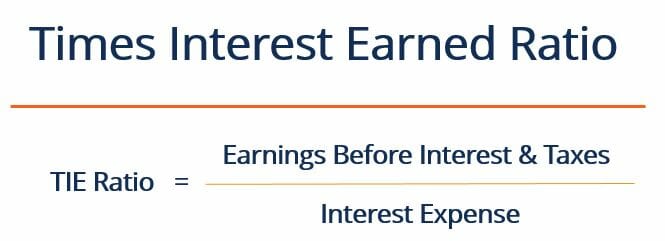
The Times Interest Earned ratio can be calculated by dividing a company’s earnings before interest and taxes (EBIT) by its periodic interest expense. The formula to calculate the ratio is:
Where:
Earnings Before Interest & Taxes (EBIT) – represents profit that the business has realized, without factoring in interest or tax payments
Interest Expense – represents the periodic debt payments that a company is legally obligated to make to its creditors
Generally speaking, the higher the TIE ratio, the better. However, a company with an excessively high TIE ratio could indicate a lack of productive investment by the company’s management. An excessively high TIE suggests that the company may be keeping all of its earnings without re-investing in business development through research and development or through pursuing positive NPV projects. This may cause the company to face a lack of profitability and challenges related to sustained growth in the long term.
Times Interest Earned Ratio Example
Harry’s Bagels wants to calculate its times interest earned ratio in order to get a better idea of its debt repayment ability. Below are snippets from the business’ income statements:
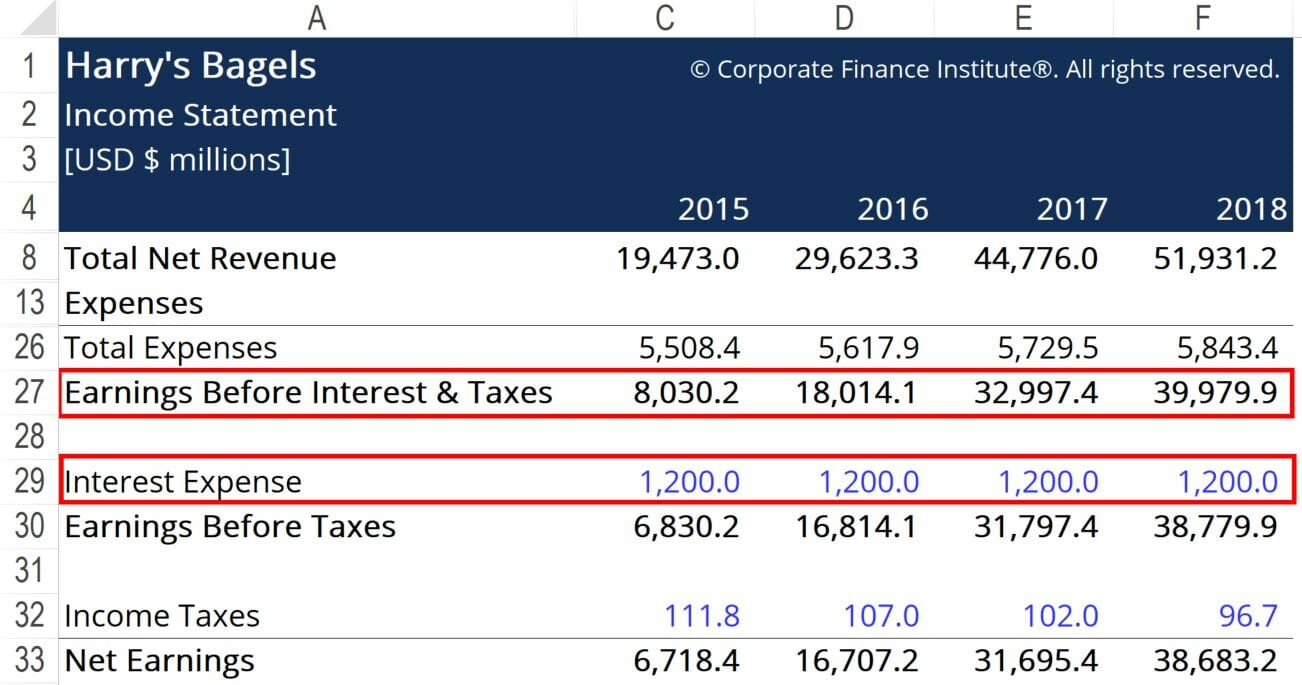
The red boxes highlight the important information that we need to calculate TIE, namely EBIT and Interest Expense. Using the formula provided above, we arrive at the following figures:
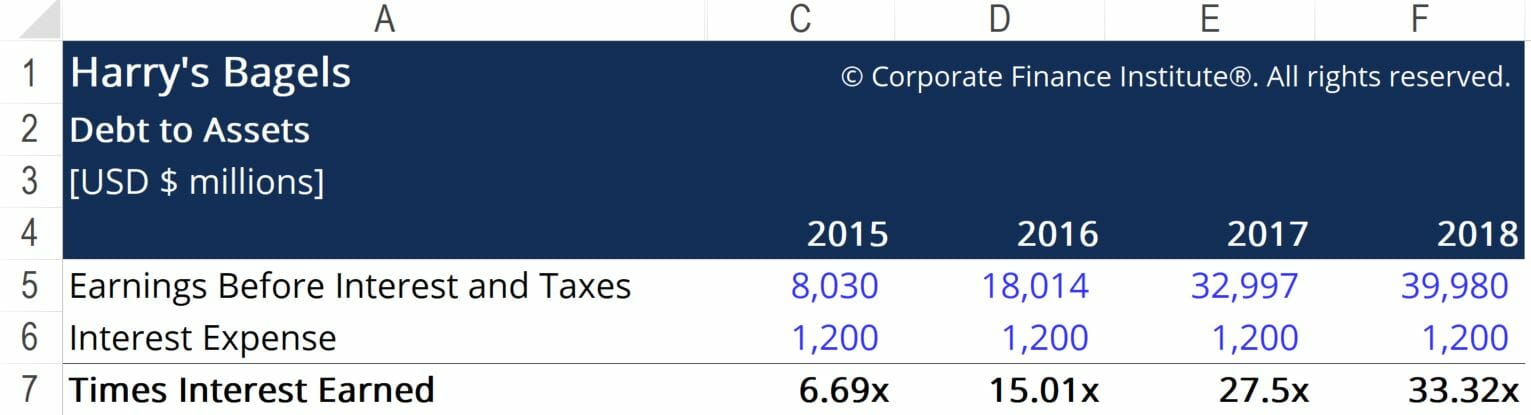
Here, we can see that Harrys’ TIE ratio increased five-fold from 2015 to 2018. This indicates that Harry’s is managing its creditworthiness well, as it is continually able to increase its profitability without taking on additional debt. If Harry’s needs to fund a major project to expand its business, it can viably consider financing it with debt rather than equityDebt vs Equity FinancingDebt vs Equity Financing - which is best for your business and why? The simple answer is that it depends. The equity versus debt decision relies on a large number of factors such as the current economic climate, the business' existing capital structure, and the business' life cycle stage, to name a few..
To better understand the financial health of the business, the ratio should be computed for a number of companies that operate in the same industry. If other firms operating in this industry see TIE multiples that are, on average, lower than Harry’s, we can conclude that Harry’s is doing a relatively better job of managing its degree of financial leverage. In turn, creditors are more likely to lend more money to Harry’s, as the company represents a comparably safe investment within the bagel industry.
Additional Resources
Thank you for reading this CFI article on the Times Interest Earned ratio! CFI offers the Financial Modeling & Valuation Analyst (FMVA)™Become a Certified Financial Modeling & Valuation Analyst (FMVA)®CFI's Financial Modeling and Valuation Analyst (FMVA)® certification will help you gain the confidence you need in your finance career. Enroll today! certification program for those looking to take their careers to the next level. To learn more about related topics, check out the following free CFI resources:
- How to Calculate Debt Service Coverage RatioHow to Calculate Debt Service Coverage RatioThis guide will describe how to calculate the Debt Service Coverage Ratio. First, we will go over a brief description of the Debt Service Coverage Ratio, why it is important, and then go over step-by-step solutions to several examples of Debt Service Coverage Ratio Calculations.
- Current Portion of Long-Term DebtCurrent Portion of Long-Term DebtThe current portion of long-term debt is the portion of long-term debt due that is due within a year’s time. Long-term debt has a maturity of
- Accounting Fundamentals Course – CFI
- Defensive Interval RatioDefensive Interval RatioThe defensive interval ratio (DIR) is a financial liquidity ratio that indicates how many days a company can operate without needing to tap into capital sources other than its current assets. It is also known as the basic defense interval ratio (BDIR) or the defensive interval period ratio (DIPR).
-

Understanding the Retention Ratio: Reinvesting for Growth
The retention ratio (also known as the net income retention ratio) is the ratio of a company’s retained income to its net incomeNet IncomeNet Income is a key line item, not only in the income st
-
Sharpe Ratio: Calculate & Interpret Investment Performance
Named after American economist, William Sharpe, the Sharpe Ratio (or Sharpe Index or Modified Sharpe Ratio) is commonly used to gauge the performance of an investment by adjusting for its risk.The hig
finance
- Acid-Test Ratio: Understanding Your Company's Short-Term Liquidity
- Asset Turnover Ratio: Definition & Calculation - Financial Analysis
- Debt-to-Asset Ratio: Definition, Calculation & Significance
- Defensive Interval Ratio (DIR): Understanding Company Liquidity
- Understanding the Envy Ratio in Private Equity
- Net Debt to EBITDA Ratio: Understanding Company Solvency
- Pretax Margin Ratio: Definition & Analysis | Financial Insights
- Times Interest Earned Ratio (Cash Basis): Calculation & Interpretation
- Short Interest Ratio: Understanding Investor Sentiment & Market Risk
-
 Quick Ratio: Understanding Your Business's Short-Term Liquidity
The Quick Ratio, also known as the Acid-test or Liquidity ratio, measures the ability of a business to pay its short-term liabilities by having assets that are readily convertible into cashCash Equiva...
-
 Reserve Ratio Explained: Understanding Bank Reserves
The reserve ratio – also known as bank reserve ratio, bank reserve requirement, or cash reserve ratio – is the percentage of deposits a financial institution must hold in reserve as cash. ...