
Loan Life Coverage Ratio (LLCR): Definition & Importance
The Loan Life Coverage Ratio (LLCR) is a metric used to gauge the ability of a project to completely cover its debt obligations. The LLCR is a very commonly used ratio to assess the potential risks of projects in project financeProject Finance - A PrimerProject finance primer. Project finance is the financial analysis of the complete life-cycle of a project. Typically, a cost-benefit analysis is used to. This coverage ratioCoverage RatioA Coverage Ratio is used to measure a company’s ability to pay its financial obligations. A higher ratio indicates a greater ability to meet obligations can be taken at any point in time of the project. It can be calculated by taking the net present value of all cash flow available for debt service (CFADS) up until the time of debt maturity and dividing it by the total outstanding debt at this given point in time.

Summary
The Loan Life Coverage Ratio (LLRC) is a commonly used metric in project finance.
- The LLRC is used to gauge a project’s ability to pay the total debt outstanding at a given point in time.
- The ratio is calculated by taking the net present value of cash flow available for debt service and dividing it by the total outstanding debt at the chosen time.
Why is the Loan Life Coverage Ratio (LLCR) Important?
Similar to the debt service coverage ratio (DSCR), the LLCR is an important ratio used in project finance. In any project finance undertaking, calculating both ratios is a standard step in assessing the project. However, unlike the DSCR, which measures the project’s ability to pay debt period-on-period, the LLCR takes into account multiple periods of cash flow available for debt service, as well as the entire amount of debt outstanding.
LLCR assesses the project’s ability to pay off all debt obligations based on the discounted projected cash flows. It gives a better estimation of the risk profile of the project as a whole.
How Do You Calculate the Loan Life Coverage Ratio (LLCR)?
The loan life coverage ratio is calculated by taking the net present valueNet Present Value (NPV)Net Present Value (NPV) is the value of all future cash flows (positive and negative) over the entire life of an investment discounted to the present. of cash flow available for debt service and adding any available cash in the cash reserve. We then take the number and divide it by the total outstanding debt in the given time.
The LLCR can be calculated at any time; however, the remaining CFADS must be discounted to the chosen point in time. The total outstanding debt used in the calculation must also correspond to this point in time.
Following is the equation for calculating the LLCR:
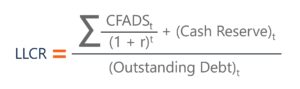
When calculating the LLCR, the ratio is generally calculated either annually, semi-annually, or quarterly over the remaining lifetime of the loan.
Loan Life Coverage Ratio (LLCR) – Worked Example
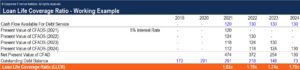
Let us take a look at a simple loan life coverage ratio example question. Shown below is the hypothetical cash available for debt service over the period of a project. The projected cash flows are discounted to a specific period in time each year and then totaled. The number divided by the total debt outstanding at the given time gives the LLCR.
If you would like to learn more about financial modeling, check out CFI’s Financial Modeling Courses.
Additional Resources
CFI is the official provider of the Financial Modeling and Valuation Analyst (FMVA)®Become a Certified Financial Modeling & Valuation Analyst (FMVA)®CFI's Financial Modeling and Valuation Analyst (FMVA)® certification will help you gain the confidence you need in your finance career. Enroll today! certification program, designed to transform anyone into a world-class financial analyst.
In order to help you become a world-class financial analyst and advance your career to your fullest potential, these additional resources will be very helpful:
- Cash Flow Available for Debt Service (CFADS)Cash Flow Available For Debt Service (CFADS)Cash Flow Available for Debt Service (CFADS) is an accurate indicator of a project's ability to generate cash flows and pay off debt obligations.
- Project FinanceProject Finance - A PrimerProject finance primer. Project finance is the financial analysis of the complete life-cycle of a project. Typically, a cost-benefit analysis is used to
- Debt Service Coverage Ratio (DSCR)Debt Service Coverage RatioThe Debt Service Coverage Ratio (DSCR) measures the ability of a company to use its operating income to repay all its debt obligations, including repayment of principal and interest on both short-term and long-term debt.
- Coverage RatiosCoverage RatioA Coverage Ratio is used to measure a company’s ability to pay its financial obligations. A higher ratio indicates a greater ability to meet obligations
-

Understanding the Retention Ratio: Reinvesting for Growth
The retention ratio (also known as the net income retention ratio) is the ratio of a company’s retained income to its net incomeNet IncomeNet Income is a key line item, not only in the income st
-
Sharpe Ratio: Calculate & Interpret Investment Performance
Named after American economist, William Sharpe, the Sharpe Ratio (or Sharpe Index or Modified Sharpe Ratio) is commonly used to gauge the performance of an investment by adjusting for its risk.The hig
finance
- Asset Coverage Ratio: Understanding Financial Solvency
- Cash Flow to Debt Ratio: Understanding and Calculation
- Coverage Ratio: Understanding Your Company's Debt Repayment Ability
- Debt Service Coverage Ratio (DSCR): Definition & Calculation
- Debt-to-Asset Ratio: Definition, Calculation & Significance
- Debt-to-Assets Ratio: Definition, Calculation & Risk Assessment
- Debt-to-Equity Ratio: Definition, Calculation & Importance
- Net Debt to EBITDA Ratio: Understanding Financial Leverage
- Loan-to-Value (LTV) Ratio: Understanding Risk & Home Equity
-
 Quick Ratio: Understanding Your Business's Short-Term Liquidity
The Quick Ratio, also known as the Acid-test or Liquidity ratio, measures the ability of a business to pay its short-term liabilities by having assets that are readily convertible into cashCash Equiva...
-
 Reserve Ratio Explained: Understanding Bank Reserves
The reserve ratio – also known as bank reserve ratio, bank reserve requirement, or cash reserve ratio – is the percentage of deposits a financial institution must hold in reserve as cash. ...